– Staff Research Associate, UCLA Immunogenetics Center, United States
Aim: Killer immunoglobulin-like receptors (KIR) play an important role in the regulation of NK cell alloreactivity following allogeneic hematopoietic stem cell transplantation (aHSCT). As such, accuracy in the assignment of KIR gene content is essential. In this study, we provide an update on interlaboratory variability in KIR genotyping among labs using different methodologies and reagents.
Methods: In 2005, the UCLA Immunogenetics Center developed an external proficiency testing (EPT) program for KIR genotyping. Participants examine 6 DNA samples two times per year. Data collected include KIR genotypes, typing method, and kit information.
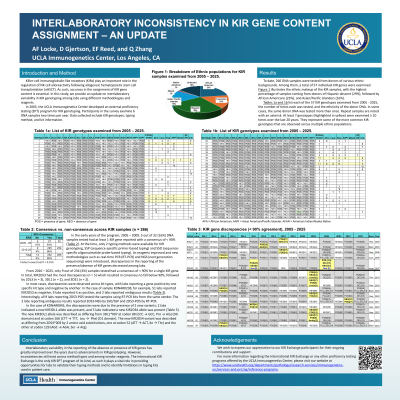
Results: This study provides an update on KIR genotyping advancements over the last 2 decades. To date, 266 DNA samples and 57 individual KIR genes were examined by participants. In the early years of the program, 2005 – 2009, 5 out of 32 (16%) samples tested had at least 1 KIR gene reported with a consensus of < 90%. At the time, only 2 typing methods were available for KIR genotyping, SSP (sequence-specific primer-based typing) and SSO (sequence-specific oligonucleotide probe-based typing). As reagents improved and new methodologies such as real-time PCR (RT-PCR) and NGS (next generation sequencing) were introduced, we observed a decrease in discrepancies. From 2010 – 2024, only 9 out of 234 (4%) samples tested had a consensus of < 90% for a single KIR gene. In total, KIR2DS3 had the most discrepancies (n = 5) which resulted in consensus to fall below 90%, followed by 2DL3 (n = 3), 3DL1 (n = 2), and 3DS1 (n = 2) (Table 1). In most cases, discrepancies were across kit types, with labs reporting a gene positive by a particular kit type and negative by another. In the case of sample 238, for example, 51 labs reported KIR2DS3 as negative, 9 labs reported it as positive, and 2 labs reported ambiguous results (Table 1). Interestingly, all 9 labs reporting 2DS3 as positive used kits from the same vendor.
Conclusion: Interlaboratory variability in the reporting of the absence or presence of KIR genes has greatly improved over the years. However, inconsistencies still exist across method types and among vendor reagents. The International KIR Exchange is the only KIR EPT program of its kind, and as such it plays a vital role in providing opportunities for labs to validate their typing methods and to identify limitations in typing kits used in patient care.