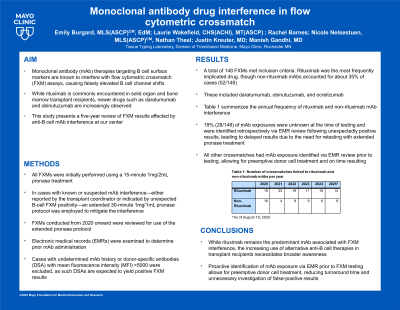
Aim: Monoclonal antibody (mAb) therapies targeting B cell surface markers are known to interfere with flow cytometric crossmatch (FXM) assays, causing falsely elevated B cell channel shifts. While rituximab is commonly encountered in solid organ and bone marrow transplant recipients, newer drugs such as daratumumab and obinutuzumab are increasingly observed. This study presents a five-year review of FXM results affected by anti-B cell mAb interference at our center.
Methods: All FXMs were initially performed using a 15-minute 1mg/2mL pronase treatment. In cases with known or suspected mAb interference—either reported by the transplant coordinator or indicated by unexpected B-cell FXM positivity—an extended 30-minute 1mg/1mL pronase protocol was employed to mitigate the interference. FXMs conducted from 2020 onward were reviewed for use of the extended pronase protocol. Electronic medical records (EMRs) were examined to determine prior mAb administration. Cases with undetermined mAb history or donor-specific antibodies (DSA) with mean fluorescence intensity (MFI) >5000 were excluded, as such DSAs are expected to yield positive FXM results.
Results: A total of 139 FXMs met inclusion criteria. Rituximab was the most frequently implicated drug, though non-rituximab mAbs accounted for approximately one-third of cases (47/139). These included daratumumab, obinutuzumab, and ocrelizumab. Table 1 summarizes the annual frequency of rituximab and non-rituximab mAb interference. 19% (27/139) of mAb exposures were unknown at the time of testing and were identified retrospectively via EMR review following unexpectedly positive results, leading to delayed results due to the need for retesting with extended pronase treatment. All other crossmatches had mAb exposure identified via EMR review prior to testing, allowing for preemptive donor cell treatment and on time resulting.
Conclusion: While rituximab remains the predominant mAb associated with FXM interference, the increasing use of alternative anti-B cell therapies in transplant recipients necessitates broader awareness. Proactive identification of mAb exposure via EMR prior to FXM testing allows for preemptive donor cell treatment, reducing turnaround time and unnecessary investigation of false-positive results.