(218) The Combined Effect of Tacrolimus Intrapersonal Variability and Donor-specific HLA Antibodies on Kidney Allograft Outcomes: Implications for CYP3A5 Genotyping
– Assistant Professor, Administrative Director of Immunogenetics and Cellular Immunology, Columbia University, United States
Aim: This study investigates the impact of intrapersonal variability (IPV) in tacrolimus trough concentrations and the development of donor-specific HLA antibodies (DSAs) on allograft survival in kidney transplant recipients. Additionally, it aims to determine whether the combination of high IPV (>30%) and the presence of DSAs further compromises graft survival.
Methods: This observational retrospective cohort study analyzed data from 521 adult kidney allograft recipients transplanted at Columbia University Irving Medical Center between 2015 and 2018.
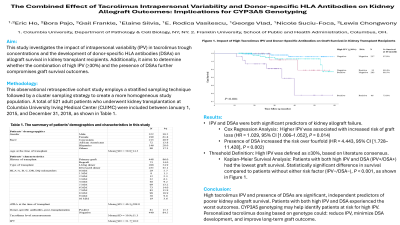
Results: Cox regression analysis identified two significant predictors of kidney allograft survival and the presence of DSAs. IPV was significantly associated with allograft survival at 60 months (HR = 1.029, 95% CI [1.006–1.052], p = 0.014), indicating that each unit increase in IPV corresponded to a 2.9% increase in the risk of graft failure. Similarly, DSA emerged as a strong predictor of graft loss (HR = 4.443, 95% CI [1.728–11.428], p < 0.002), suggesting that patients with DSA had more than a fourfold higher risk of graft failure compared to those without. The study further examined whether the combined presence of high IPV and DSA significantly impacted graft survival. Kaplan-Meier survival analysis was conducted to compare survival outcomes among four groups: high IPV+/DSA+ (n = 46), high IPV+/DSA− (n = 203), high IPV−/DSA+ (n = 35), and high IPV−/DSA− (n = 237). The results demonstrated that patients in the high IPV+/DSA+ group had significantly lower graft survival than those in the high IPV−/DSA− group (p < 0.001).
Conclusion: This study demonstrates that high IPV in tacrolimus trough concentration levels and the development following transplantation of donor-specific HLA antibodies are significant predictors of inferior kidney allograft survival. Notably, patients with both high IPV and DSAs exhibited the poorest graft outcomes compared to those without either risk factor. These findings suggest that CYP3A5 genotyping—given its role in tacrolimus metabolism—may offer clinical utility in identifying patients at increased risk for high IPV. Implementing personalized dosing strategies based on the CYP3A5 genotype could help stabilize tacrolimus exposure, potentially mitigating the development of DSAs and improving long-term graft survival.
Footnotes: The Cox proportional hazards regression analyses were previously used in my doctoral dissertation to identify predictors of graft failure.