– Research Scientist, Thermofisher Scientific, United States
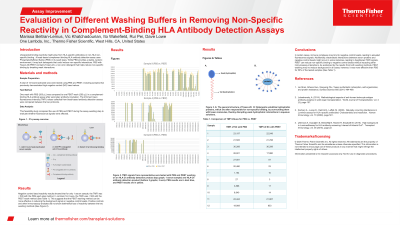
Aim: Unexpected binding reactivity might arise from HLA-specific antibodies or non-HLA non-specific binding. A bead-based complement binding HLA antibody detection assay uses Phosphate-Buffered Saline (PBS) in its wash steps. While PBS provides a stable, isotonic environment, it may lack detergents that could reduce non-specific interactions. PBS with Tween-20 (PBST) contains Tween-20, a non-ionic detergent that helps reduce non-specific binding by breaking weak interactions. This feasibility study compared the use of PBS and PBST during the assay washing step to evaluate whether fluorescence signals were affected.
Methods: One wash with PBS (200 µL) was compared to one PBST wash (200 µL) in a complement-binding HLA antibody assay after secondary antibody incubation. The trimmed mean fluorescence intensity (TMFI) values collected from bead-based antibody detection assays were compared between the two protocols.
Results: A total of 12 sera were tested using PBS and PBST including samples which previously demonstrated high negative control (NC) bead values. Negative control bead reactivity results showed that for only 1 serum sample, the TMFI was < 500 with the PBS wash step method. In contrast, for 6 sera, the TMFI was < 500 with the PBST wash method (See Table 1). This suggests that the PBST washing method can be more effective in reducing the background signal on negative control beads. Positive controls and other immunoassay analytes did not show detrimental loss of reactivity between the two washing methods (See Figure 1).
Conclusion: In certain cases, immune complexes may bind to negative control beads, leading to elevated fluorescence signals. Additionally, electrostatic interactions between serum proteins and negative control beads might occur in some instances, leading to heightened TMFI signals. PBST can reduce non-specific binding to negative control beads without impacting other immunoassay interactions. As evidenced by the results from both washing methods, PBST washing may not reduce background in all cases; however, it was more effective than PBS for 50% of the tested samples (See Table 1).