– Deputy Chief, National Laboratory of Immunogenetics (INCUCAI), INCUCAI – National Institute for Organ Allocation and Transplant Coordination, Argentina
Aim: To evaluate the real-world availability and HLA compatibility of unrelated stem cell donors requested through international registries in Argentina, and to correlate this with clinical outcomes, including type of transplant performed, time to transplantation, and patient survival.
Methods: A retrospective analysis was conducted on all unrelated donor requests processed through the Argentinian National Registry (AR, ION-5117) between January 1 and December 31, 2024, with preliminary data from January–April 2025. Donor requests were classified by registry of origin and outcome (available, not available, pending), and HLA compatibility was normalized (e.g., 10/12, 12/12, 16/16). In parallel, a clinical cohort of 38 patients who initiated donor search between November 1 and December 31, 2024, was analyzed to assess transplant type, waiting time, and clinical outcome.
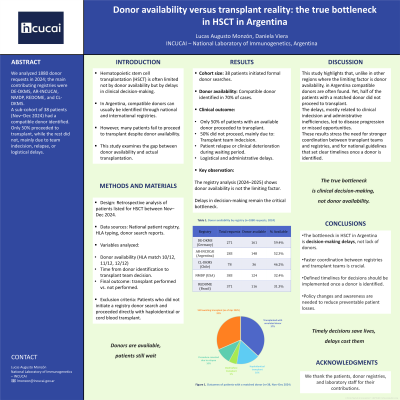
Results: In 2024, 1,179 donor requests were analyzed. The highest donor availability rates were observed in DE-DKMS (Germany, 58.0%), AR (Argentina, 49.9%), and CL-DKMS (Chile, 43.8%), while NMDP (USA, 32.7%) and REDOME (Brazil, 27.4%) showed lower fulfillment. Among these, DE-DKMS contributed the highest number of fully matched donors (n=29 with 12/12 or 16/16), followed by AR (n=18), NMDP (n=11), and REDOME (n=7). Among the 38 patients in the November–December 2024 clinical cohort: 14 patients (36.8%) received a transplant with an unrelated donor, 6 patients (15.8%) had a haploidentical transplant, 2 patients (5.3%) died before transplantation, 4 patients (10.5%) had their procedures canceled due to disease relapse, 12 patients (31.6%) were still awaiting transplantation as of the data cutoff in April 2025. The average time from formal search initiation to transplant was 123 days.
Conclusion: Donor availability and HLA compatibility vary widely across international registries. While some registries demonstrate high donor fulfillment and match rates, timely transplantation depends on coordinated clinical decision-making and logistical execution. In our cohort, nearly half of the patients did not undergo transplantation within five months of initiating donor search, despite having compatible donors identified. These findings underscore the importance of aligning donor search strategies with clinical urgency and health system responsiveness to improve access and outcomes in allogeneic transplantation.

.jpg "Lucas A. Monzon, Biochemist photo")