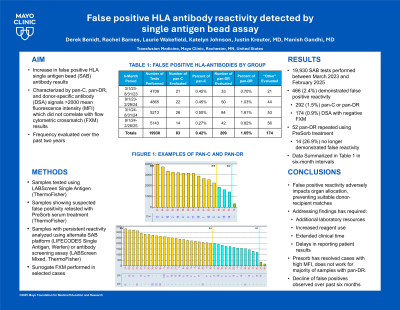
Aim: In recent years, our institution has observed an increase in false positive HLA antibody results using the single antigen bead (SAB) assay (LABScreen Single Antigen, ThermoFisher). These were characterized by pan-C, pan-DR reactivity, and donor-specific antibody (DSA) signals with mean fluorescence intensity (MFI) >2000, which did not correlate with flow cytometric crossmatch (FXM) results. Given the critical role of accurate antibody identification in virtual crossmatching for organ acceptance, we evaluated the frequency of false positive SAB results at our center over the past two years.
Methods: Samples showing suspected pan-C, pan-DR, or DSA reactivity with negative FXM were retested following serum treatment with PreSorb (ThermoFisher). Samples with persistent reactivity were further analyzed using an alternative SAB platform (LIFECODES Single Antigen, Werfen) or an antibody screening assay (LABScreen Mixed, ThermoFisher). Surrogate FXM was also performed in selected cases.
Results: Of the 19,930 SAB tests performed between March 2023 and February 2025, 466 (2.4%) demonstrated false positive reactivity. Of these, 292 (1.5%) exhibited pan-C or pan-DR reactivity, and 174 (0.9%) showed DSA with negative FXM. 52 tests that exhibited pan-DR were repeated using the PreSorb treatment, and 14 (26.9%) of those samples no longer demonstrated false reactivity. Data on false positive reactivity is summarized in six-month intervals in Table 1. An increasing trend was observed during the first 18 months, followed by a decline in the most recent six months. Table 2 presents additional top five reactivity patterns in samples with DSA and negative FXM.
Conclusion: False positive reactivity associated with SAB reagents from a single vendor may adversely impact organ allocation by preventing suitable donor-recipient matches. Addressing these findings has required additional laboratory resources, increased reagent use, extended clinical time, and delays in reporting patient results. The implementation of PreSorb has resolved cases with high MFI, but does not work for majority of the samples with pan-DR. Encouragingly, a decline in false positive cases has been observed over the past six months, and ongoing monitoring will be essential.