– Director in Training, Virginia Commonwealth University
Aim: The virtual crossmatch (VXM) has been defined as an assessment of immunologic compatibility using a recipient’s antibody profile and a donor’s HLA antigens. With recent CMS approval of the VXM as an alternative to the physical crossmatch, an ASHI and CAP-sponsored working group raised questions about the qualifications required to perform VXMs (Sullivan et al. 2025). At Virginia Commonwealth University, VXMs are treated as antibody assessments rather than clinical consults, and high VXM volume necessitates a workflow in which technologists can conduct VXMs. In some cases, a VXM may necessitate an additional clinical consult which would be done by the laboratory director as needed. This study aims to demonstrate that comprehensive training and standardized workflows allow technologists to perform VXMs accurately and reliably.
Methods: Between 01/01/2025 and 03/31/2025, technologists completed VXMs for 153 deceased donors, totaling 296 donor-patient pairs. Antibody profiles were pre-established during routine clinical testing with antibody risk stratification determinations based on strength, shared eplets, self-reactivity, and sensitization history. For this study, each VXM was retrospectively reviewed for accuracy in donor typing translation and VXM assessment. Discrepancies were categorized by error type, severity, and whether they reflected deviation from the lab’s SOP or a knowledge gap that could benefit from further education.
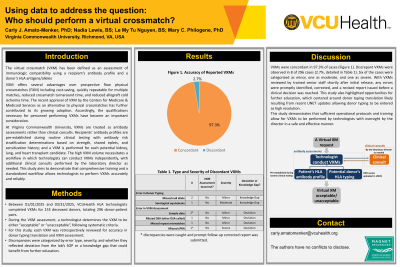
Results: VXMs were concordant in 97.3% of cases (Figure 1). Discrepant VXMs were observed in 8 of 296 cases (2.7%, detailed in Table 1). Six of the cases were categorized as minor, one as moderate, and one as severe. Importantly, the severe error, in which a VXM was incorrectly called acceptable although the patient had a cPRA ≥ 80%, was recognized in real-time and a corrected VXM issued before a clinical decision was reached. This study also highlighted opportunities for further education, which centered around donor typing translation likely resulting from recent UNET updates allowing donor typing to be entered as high resolution.
Conclusion: This study demonstrates that sufficient operational protocols and training allow for VXMs to be performed by technologists with oversight by the director in a safe and effective manner.