– Lead Technologist, Johns Hopkins University Immunogenetics Laboratory, United States
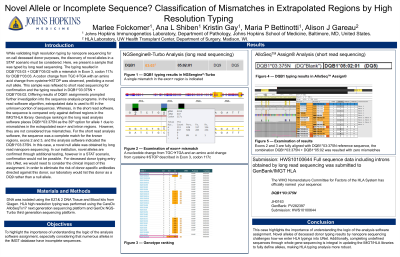
Body: While validating high resolution typing by nanopore sequencing for on-call deceased donor purposes, the discovery of novel alleles in a STAT scenario must be considered. Here, we present a sample that was typed by long read sequencing. The typing resulted in DQB1*03:03 + DQB1*05:02 with a mismatch in Exon 3, codon 117c for DQB1*03:03. A codon change from TGC-->TGA with an amino acid change from cysteine-->STOP was observed, predicting a novel null allele. This sample was reflexed to short read sequencing for confirmation and the typing resulted in DQB1*03:375N + DQB1*05:02. Differing results of DQB1 assignments prompted further investigation into the sequence analysis programs. In the long read software algorithm, extrapolated data is used to fill in the unknown portion of sequences. Whereas, in the short read software, the sequence is compared only against defined regions in the IMGT/HLA library. Genotype ranking in the long read analysis software places DQB1*03:375N as the 35th option for allele 1 due to mismatches in the extrapolated exon+ and intron regions. However, they are not considered true mismatches. For the short read analysis software, the sequence was a complete match for the known regions, exons 2 and 3, and the analysis software indicated the DQB1*03:375N. In this case, a novel null allele was obtained by long read nanopore sequencing, but in a STAT scenario, confirmation would not be possible. For deceased donor typing entry into UNet, we would need to consider the clinical impact of this assignment. In order to eliminate the risk of donor-specific antibodies directed against this donor, our laboratory would list this donor as a DQ9 rather than a null allele.
Conclusion: This case highlights the importance of understanding the logic of the analysis software assignment, especially considering that numerous alleles in the IMGT database have incomplete sequences. Novel alleles of deceased donor typing results by nanopore sequencing challenges how we enter HLA typings into UNet. Additionally, completing undefined sequences through whole gene sequencing is integral in updating the IMGT/HLA libraries to fully define alleles.