(710) Analytical Performance of Targeted Long-Read HiFi Sequencing to Detect Pharmacogenomic HLA-A and -B Alleles Implicated in Drug-Induced Hypersensitivity Reactions
– Associate Professor, Stanford University, United States
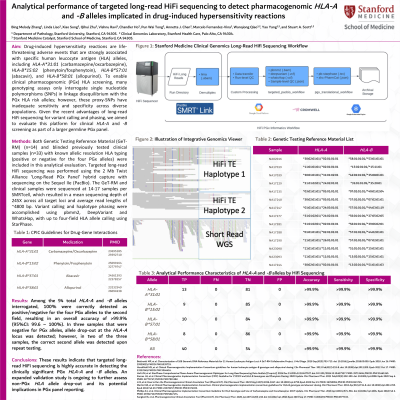
Aim: Drug-induced hypersensitivity reactions are life-threatening adverse events that are strongly associated with specific human leucocyte antigen (HLA) alleles, including HLA-A*31:01 (carbamazepine/oxcarbazepine), HLA-B*15:02 (phenytoin/fosphenytoin), HLA-B*57:01 (abacavir), and HLA-B*58:01 (allopurinol). To enable clinical pharmacogenomic (PGx) HLA screening, many genotyping assays only interrogate single nucleotide polymorphisms (SNPs) in linkage disequilibrium with the PGx HLA risk alleles; however, these proxy-SNPs have inadequate sensitivity and specificity across diverse populations. Given the recent advantages of long-read HiFi sequencing for variant calling and phasing, we aimed to evaluate this platform for clinical HLA-A and -B screening as part of a larger germline PGx panel.
Methods: Both Genetic Testing Reference Material (GeT-RM) (n=14) and blinded previously tested clinical samples (n=33) with known allelic resolution HLA typing (positive or negative for the four PGx alleles) were included in this analytical evaluation. Targeted long-read HiFi sequencing was performed using the 2 Mb Twist Alliance ‘Long-Read PGx Panel’ hybrid capture with sequencing on the Sequel IIe (PacBio). The GeT-RM and clinical samples were sequenced at 14-17 samples per SMRTcell, which resulted in a mean sequencing depth of 245X across all target loci and average read lengths of ~4800 bp. Variant calling and haplotype phasing were accomplished using pbmm2, DeepVariant and WhatsHap, with up to four-field HLA allele calling using StarPhase.
Results: Among the 94 total HLA-A and -B alleles interrogated, 100% were correctly detected as positive/negative for the four PGx alleles to the second field, resulting in an overall accuracy of >99.9% (95%CI: 99.6 – 100%). In three samples that were negative for PGx alleles, allele drop-out at the HLA-A locus was detected; however, in two of the three samples, the correct second allele was detected upon repeat testing.
Conclusion: These results indicate that targeted long-read HiFi sequencing is highly accurate in detecting the clinically significant PGx HLA-A and -B alleles. An expanded validation study is ongoing to further assess non-PGx HLA allele drop-out and its potential implications in PGx panel reporting.