– Life Science Research Assistant, Stanford Blood Center, United States
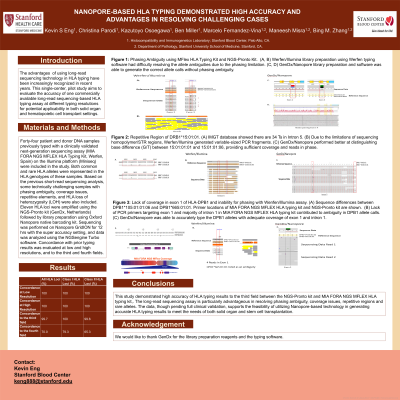
Aim: The advantages of using long-read sequencing technology in HLA typing have been increasingly recognized in recent years. This single-center pilot study aims to evaluate the accuracy of one commercially available long-read sequencing-based HLA typing assay at different typing resolutions for potential applicability in both solid organ and hematopoietic cell transplant settings.
Methods: Forty-four patient and donor DNA samples previously typed with a clinically validated next-generation sequencing assay (MIA FORA NGS MFLEX HLA Typing Kit, Werfen, Spain) on the Illumina platform (Miniseq) were included in the study. Both common and rare HLA alleles were represented in the HLA genotypes of these samples. Based on the previous short-read sequencing analysis, some technically challenging samples with phasing ambiguity, coverage issues, repetitive elements, and HLA loss of heterozygosity (LOH) were also included. Eleven HLA loci were amplified using the NGS-Pronto kit (GenDx, Netherlands) followed by library preparation using Oxford Nanopore native barcoding kit. Sequencing was performed on Nanopore GridION for 12 hrs with the super accuracy setting, and data was analyzed using the NGSengine Turbo software. Concordance with prior typing results was evaluated at low and high resolutions, and to the third and fourth fields.
Results: Of a total of 792 locus-specific results evaluated, the overall concordance rates are 100% at both low and high resolutions, and 99.7% and 70.0% to the third and fourth fields, respectively. (Table 1). Two samples with LOH and one sample with poor amplification were excluded from the concordance analysis. With long-read sequencing, phasing ambiguity, repetitive elements, and variants in low coverage regions were resolved. Rare alleles and LOH were correctly detected.
Conclusion: This study demonstrated high accuracy of HLA typing results to the third field between the GenDx Nanopore typing assay and the Werfen Illumina typing assay. The long-read sequencing assay is particularly advantageous in resolving phasing ambiguity, coverage issues, repetitive elements and rare alleles. The data, though pending full clinical validation, supports the feasibility of utilizing Nanopore-based technology in generating accurate HLA typing results to meet the needs of both solid organ and stem cell transplantation.