– Immunology and Histocompatibility laboratory director, CHU de Québec-Université Laval, Canada
Aim: Antibodies directed at autoantigens have been suggested to play a role in antibody-mediated rejection (AMR). Vendors vary in the repertoires of autoantigens represented in their non-HLA kits. This study aimed to establish consistency in antibody assignment for autoantigens represented on kits from different vendors.
Methods: Pretransplant (n=167) and posttransplant (n=159) serum samples from participants in a nested case-control study were analyzed according to the manufacturer’s instructions with Werfen Non-HLA and One Lambda Autoantibody Luminex-based single antigen bead kits. Participants were patients with AMR across its continuum and randomly selected controls from a retrospective cohort (2011-2019), matched on center, year of transplant and time interval to case diagnosis. Interpretation of antibody presence relied on the manufacturers’-recommended MFI thresholds. Agreement between assays was estimated using Cohen’s kappa statistics and reported as point estimates and 95% confidence interval (95% CI). Kappa values of ≤ 0.39, 0.40 to 0.59, 0.60 to 0.79, and ≥ 0.80 suggested minimal, weak, moderate, and strong agreement between assay results, respectively.
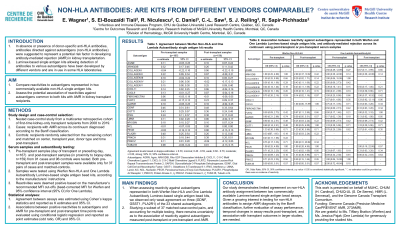
Results: Of the 23 autoantigens common to Werfen and One Lambda kits, analysis of pre-transplant samples yielded kappa estimates of 0.40 (0.25, 0.54), 0.43 (0.29, 0.57) and 0.46 (0.31, 0.61) for phospholipase 2 receptor (PLA2R), glutathione S-transferase theta 1 (GSTT1), and glial cell line-derived neurotrophic factor (GNDF), respectively. Analysis of posttransplant samples showed a kappa of 0.40 (0.48; 0.33, 0.64) for GNDF. No or minimal agreement in antibody detection by the two kits was found for all other autoantigens in pre- and post-transplant samples.
Conclusion: Our study demonstrates limited agreement on non-HLA antibody assignment between two commercially available Luminex-based non-HLA single antigen bead assays. A better understanding on the relationship between non-HLA antibodies and transplant outcomes could help inform the role of non-HLA antibodies in clinical transplantation.