(612) Work Smarter, Not Harder: A simple model for optimizing staffing needs and operational efficiency in clinical laboratories using productivity metrics
– Clinical Laboratory Scientist II, Gift of Hope Organ & Tissue Donor Network, United States
Aim: Staffing shortage is among the most critical challenges faced by clinical laboratories. There is currently no standardized approach to monitor staffing concerns and determine future needs. We have created a data driven model for an objective and systematic evaluation of laboratory productivity and staff utilization rate using existing key performance indicators.
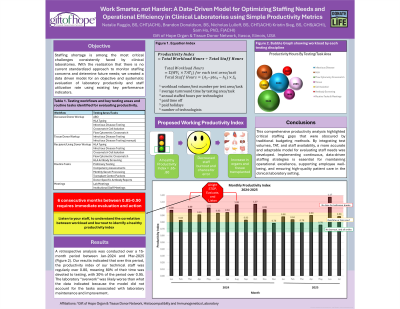
Methods: An in-depth analysis was conducted to map out the main testing workflows and identify all routine tasks in the lab (Table 1). Data was extracted from existing quality metrics which included workload volumes grouped by testing areas and the corresponding turnaround times (TAT), as well as vital lab functions. The total staff availability was determined using the calculation in Figure 1.
Results: Our model of evaluating productivity index was simply the % of staff utilization, which was calculated based on the total hours required to complete all testing and functions divided by the total available staff hours. A retrospective analysis was conducted over a 15-month period between Jan-2024 and Mar-2025 (Figure 2). Our results indicated that over this period, the productivity index of our technical staff was regularly over 0.80, meaning 80% of their time was devoted to testing, with 30% of the period over 0.95. The laboratory “overwork” was likely worse than what the data indicated because the model did not account for the tasks associated with laboratory maintenance and improvement. Based on our data and observation, we believe that a monthly productivity index of 0.65-0.80 should be considered “healthy” for lab growth and staff balancing between productivity and resource utilization. Conversely, 3 consecutive months over 0.95 or a 6-month running average of 0.85-0.90 warrant immediate action to evaluate and address staffing needs to avoid staff burnout.
Conclusion: This comprehensive productivity analysis highlighted critical staffing gaps that were obscured with traditional budgeting methods. By integrating test volumes, TAT, and staff availability, a more accurate and adaptable model for evaluating staff needs was developed. Implementing continuous, data-driven staffing strategies is essential for maintaining operational excellence, supporting employee well-being, and ensuring high-quality patient care in the clinical laboratory setting.