– HLA Molecular Analyst, ClinImmune - The Center for Clinical Immunology
Body: Next Generation Sequencing (NGS) has revolutionized the field of transplantation because it allows multiple patients to be rapidly typed at high resolution. However, when failure occurs during an NGS run, the impact is greater since many samples are affected, and the cost of reagents is high. Therefore, it is critical to quickly determine the cause and mitigate any future issues.
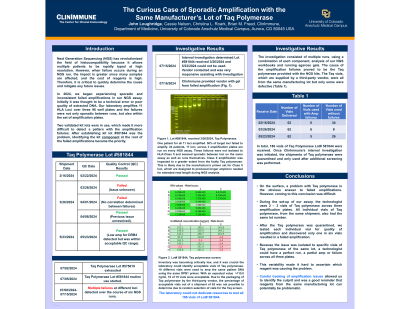
In 2024, we began experiencing sporadic and inconsistent failed amplifications in our NGS assay. Initially it was thought to be a technological error or poor quality of extracted DNA. Our laboratory amplifies 11 HLA Loci over three 96 well plates and the failures were not only sporadic between runs, but also within the set of amplification plates.
We noticed that two validated kit lots were in use, which made it more difficult to detect a pattern with the amplification failures. After establishing which kit lot was involved, identifying the kit component at the root of the failed amplifications became the priority. The investigation consisted of multiple runs, using a combination of each component, analysis of our NGS workbooks and running agarose gels. The cause of the amplification failures proved to be the Taq polymerase inside the NGS kits. The Taq vials, which are supplied by a different vendor, were all from the same manufacturing lot but only some were inferior.
Conclusion: On the surface, a problem with Taq polymerase is the obvious answer to failed amplifications. However, coming to this conclusion was difficult. During the set-up of our assay, the technologist uses 2 – 3 vials of Taq polymerase across three amplification plates. All individual vials of Taq polymerase, from the same shipment, also had the same lot number. After the Taq polymerase was quarantined, we tested each individual vial for quality of amplification and discovered only one in six vials resulted in a failed amplification. Because the issue was isolated to specific vials of Taq polymerase of the same lot, a technologist could have a perfectly fine run, a partial amp or failure across all three plates. This variability made it hard to ascertain which reagent was causing the problem. Careful tracking of amplification issues allowed us to identify the culprit and was a good reminder that reagents from the same manufacturing lot can potentially be problematic.