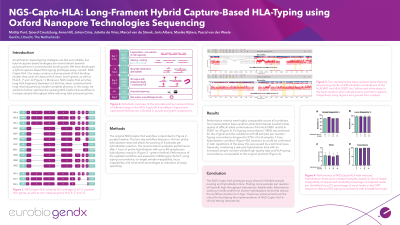
Aim: Amplification-based typing strategies are generally fast and reliable; however, mismatches under the primer binding site could lead to false homozygous typings. This may be overcome by hybrid capture-based enrichment strategies. Therefore, we are developing NGS-Capto-HLA: a long-fragment, hybrid capture-based HLA-typing method. The assay leverages a diverse panel of HLA binding probes, allowing for full coverage of the classical class I and II genes, as well as HLA-E, -F, -G. In addition, NGS-Capto-HLA features the use of long enriched HLA fragments (between 3-5 kb) that, when combined with long-read sequencing technologies, enable robust and complete phasing of the HLA loci. Here, we present our efforts towards optimizing the NGS-Capto-HLA workflow to significantly increase its throughput and flexibility.
Methods: The original NGS-Capto-HLA workflow comprises of a two-day workflow, followed by an overnight ONT sequencing run. On the first day, gDNA fragments of approximately 3-5 kb are generated through fragmentation and size selection. These fragments are indexed using an indexing PCR, after which DNA of up to 8 samples is pooled. The DNA pools are then subjected to an overnight probe hybridization step (~16 hours). On day 2, the probe-target complexes are enriched by means of streptavidin bead purification and a post-capture PCR. Finally, all samples are combined, prepared for and loaded on an ONT sequencing device, after which data analysis is done using a prototype version of NGSengine® (GenDx).
Results: Using DNA from the GeT-RM HLA58 reference panel, we have confirmed that the NGS-Capto-HLA workflow allows for the multiplexing of at least 48 DNA samples in combination with a reduced probe hybridization time of just 1 hour, without compromising on data quality or 3rd-field typing concordance.
Conclusion: Altogether, these results confirm that the current NGS-Capto-HLA device has a robust design. Labs working in shifts may benefit from reducing probe hybridization time to 1 hour, such that the original two-day workflow could be completed within a single day. By starting an overnight sequencing run at the end of this day, data will be ready for analysis the following morning, going from DNA to data within 2 days instead of the original 3 days. These key enhancements will be critical for facilitating the implementation of NGS-Capto-HLA in clinical testing laboratories.