– Assistant Director, Transplant Immunology Division, Hoxworth Blood Center, United States
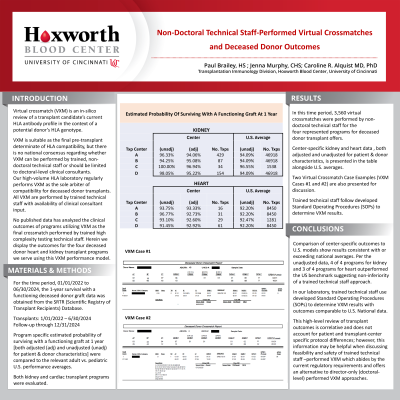
Aim: Virtual crossmatch (VXM) is an in-silico review of a transplant candidate’s current HLA antibody profile in the context of a potential donor’s HLA genotype. VXM is suitable as the final pre-transplant determinate of HLA compatibility, but there is no national consensus regarding whether VXM can be performed by trained, non-doctoral technical staff or should be limited to doctoral-level clinical consultants. Our high-volume HLA laboratory regularly performs VXM as the sole arbiter of compatibility for deceased donor transplants. All VXM are performed by trained technical staff with availability of clinical consultant input. No published data has analyzed the clinical outcomes of programs utilizing VXM as the final crossmatch performed by trained high complexity testing technical staff. Herein we display the outcomes for the four deceased donor heart and kidney transplant programs we serve using this VXM performance model.
Methods: For the time period, 07/01/2021 to 12/31/2023, the 1-year survival with a functioning deceased donor graft data was obtained from the SRTR (Scientific Registry of Transplant Recipients) Database. Program specific Estimated Probability Of Surviving With A Functioning Graft At 1 Year [both adjusted (adj) and unadjusted (unadj) for patient & donor characteristics] were compared to the relevant adult vs. pediatric U.S. performance averages. Both kidney and cardiac transplant programs were evaluated.
Results: In this time period, 3,390 virtual crossmatches were performed for the 4 represented programs/centers for deceased donor transplant offers. Kidney and heart data presented in Table 1.
Conclusion: Comparison of center-specific outcomes to US models show results consistent with or exceeding national averages. With unadj data, ¾ programs for kidney and ¾ programs for heart outperformed the US benchmark suggesting non-inferiority of a trained technical staff approach. This high-level review of transplant outcomes is correlative and does not account for patient and transplant-center specific protocol differences; however, this information may be helpful when discussing feasibility and safety of trained technical staff–performed VXM which abides by the current regulatory requirements and offers an alternative to director-only performed VXM.