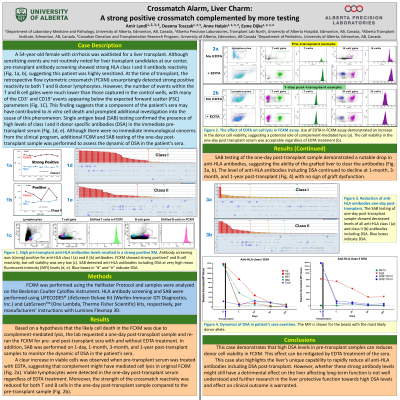
Body: Liver transplant is a life-saving treatment in end-stage liver disease. While antibody-mediated rejection risk appears low in liver transplant, high levels of donor-specific antibodies (DSA) can still pose challenges in patient management. A 54-year-old female with cirrhosis received a liver transplant. Sensitizing events are not routinely noted for liver transplant candidates at our center, but pre-transplant antibody screening showed strong HLA class I and II antibody reactivity, suggesting this patient was highly sensitized. The flow crossmatch (FCXM) that is routinely retrospectively performed for liver transplant at our center was strong positive for both T and B cells. Many CD3+ as well as CD19+ cells were falling below the expected forward scatter (FSC) gate suggesting cell death. Single antigen bead testing confirmed high levels of class I and II DSA, supporting the FCXM result. Although there were no immunologic concerns upon communication to the program, our laboratory requested a one-day post-transplant sample for monitoring; a notable drop in DSA was seen in this sample which continued to decline at 1-month, 3-month, and 1-year post-transplant (Fig. 1a) with no sign of graft dysfunction. To assess if the likely cell death in the FCXM was due to complement-mediated cytotoxicity and to enable more accurate cell gating, the FCXM was repeated with and without EDTA-treated sera. There was a marked decrease in the non-viable (low FSC) cells with EDTA treatment suggesting complement was mediating cell lysis in the first FCXM. The EDTA treated sera showed higher positive shifts which may reflect a more accurate FCXM result as more cells were included in the T and B cell gates (Fig. 1b). Of note, we observed that this patient had received platelet transfusion support prior to and during the transplant surgery with poor platelet response and the program was informed that HLA matched platelets would likely yield better platelet increments if necessary.
Conclusion: This case highlights the liver's unique ability to reduce DSA post-transplant. However, class I antibodies pose a concern if platelet transfusion support is required. This also accentuates the need for communication between clinicians and the HLA laboratory. It also suggests that the effect of high levels of DSA on FCXM may require modification of the assay such as EDTA treatment of patient sera.