– Laboratory Manager, Sentara Norfolk General Hospital, United States
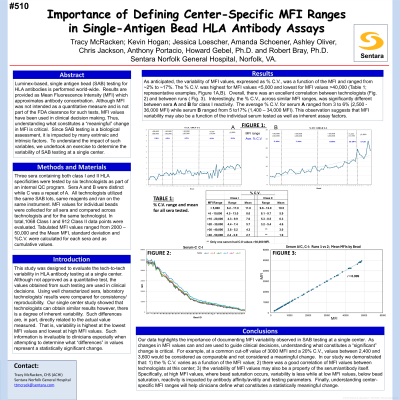
Aim: Luminex-based, single antigen bead (SAB) assays for HLA antibodies are performed world-wide. Results are provided as Mean Fluorescence Intensity (MFI) which approximates antibody concentration. Although MFI was not intended as a quantitative measure and is not part of the FDA clearance for such tests, MFI values have been used in clinical decision making. Thus, understanding what constitutes a “meaningful” change in MFI is critical. Since SAB testing is a biological assessment, it is impacted by many extrinsic and intrinsic factors. To understand the impact of such variables, we undertook an exercise to determine the variability of SAB testing at a single center.
Methods: Three sera containing both class I and II HLA specificities were tested by six technologists as part of an internal QC program. Sera A and B were distinct while C was a repeat of A. All technologists utilized the same SAB lots, reagents and ran on the same instrument. MFI values for individual beads were collected for all sera and compared across technologists and for the same technologist. In total,1068 Class I and 912 Class II data points were evaluated. Tabulated MFI values ranged from 2000 – 50,000 and the average MFI, standard deviation and %C.V. were calculated.
Results: As anticipated, the variability of MFI values, expressed as % C.V., was a function of the MFI and ranged from ~2% to ~17%. The % C.V. was highest for MFI values <5,000 and lowest for MFI values >40,000 (Table 1). Overall, there was an excellent correlation between technologists (Fig. 1 and 2). Interestingly, the % C.V., across MFI ranges, differed between sera A and B. This suggests that MFI variability may also be a function of the individual serum tested as well as the assay/technologist performance itself.
Conclusion: Our data highlight the importance of documenting MFI variability observed in SAB testing at a single center. As changes in MFI values can and are used to guide clinical decisions, understanding what constitutes a “significant” change is critical. In our study we demonstrated that: 1) the % C.V. varies as a function of the MFI value; 2) there was a good correlation in MFI values between technologists at this center; 3) reproducibility of MFI values may also be a property of the serum/antibody itself. Finally, reporting center-specific MFI ranges to clinicians will help determine what signifies a clinically meaningful change.

.jpg "Tracy Mcracken, CHS (ACHI) photo")