– Director, Hartford Hospital Crane 2
, United States
Aim: The Hartford Hospital Kidney Transplant (Tx) program has been performing virtual crossmatches (VXM) as the final approval to proceed with Tx surgery for about ten years. The majority of these VXMs are for unsensitized patients with low calculated panel reactive antibody (CPRA). The aim of this study was to determine how effective and accurate our VXM testing is in highly sensitized patients, resulting in a successful Tx outcome.
Methods: We reviewed highly sensitized patients with CPRA ≥95% (n=20), who received a kidney Tx in the past five years. The parameters selected to evaluate and compare in these patients were the following: CPRA, pre-Tx Donor Specific Antibody (DSA), VXM result (Risk assessment), flow XM result and whether a pre-Tx (Prospective) or post-Tx (Retrospective) flow XM was performed, post-Tx DSA, post-Tx creatinine (Cr) levels, rejection episodes.
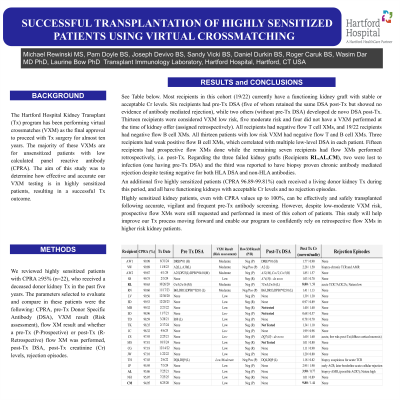
Results: See Table 1. Most recipients in this cohort (17/20) currently have a functioning kidney graft with stable or acceptable Cr levels. Six recipients had pre-Tx DSA (five of whom retained the same DSA post-Tx but showed no evidence of antibody mediated rejection), while two others (without pre-Tx DSA) developed de novo DSA post-Tx. Twelve recipients were considered VXM low risk, five moderate risk and three did not have a VXM performed at the time of kidney offer (assigned retrospectively). All recipients had negative flow T cell XMs and 17/20 recipients had negative B cell XMs. Three recipients had weak positive flow B cell XMs, which correlated with multiple low-level DSA in each patient. Fourteen recipients had prospective XMs done while the remaining six recipients had flow XMs performed retrospectively, i.e. post-Tx. Regarding the three failed kidney grafts, two were lost to infection (one having pre-Tx DSA) and the third was noted to have biopsy proven chronic antibody mediated rejection despite testing negative for both HLA DSA and non-HLA antibodies.
Conclusion: Highly sensitized kidney patients, even with CPRA values up to 100%, can be effectively and safely transplanted following vigilant and frequent pre-Tx antibody screening. However, despite low-moderate VXM risk, prospective flow XMs were still requested and performed in most of this cohort of potential recipients. This study will help improve our Tx process moving forward and enable our program to confidently rely on retrospective flow XMs in higher risk kidney patients.