– Associate Professor / HLA Laboratory Director, SUNY Upstate Medical University, United States
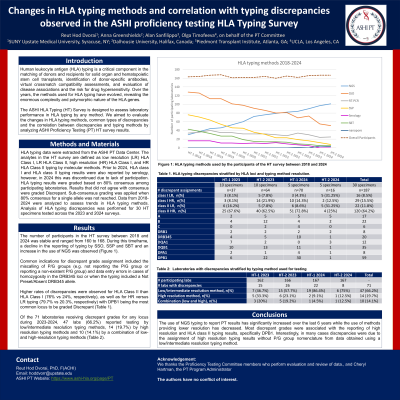
Aim: The ASHI Proficiency Testing (PT) HLA Typing (HT) Survey is designed to assess laboratory performance in HLA typing by any method. We aimed to evaluate the changes in HLA typing methods, and the correlation between typing methods and common types of discrepancies by analyzing ASHI PT HT survey results.
Methods: HLA typing data were extracted from the ASHI PT Data Center. Analytes in the HT survey are defined as low resolution (LR) HLA Class I, LR HLA Class II, high resolution (HR) HLA Class I, and HR HLA Class II typing by molecular methods. HLA typing results were graded based on 80% consensus. Results that did not agree with consensus were graded Discrepant. Sub-consensus grading was applied when 80% consensus for a single allele was not reached. Data from 2018-2024 were analyzed to assess trends in HLA typing methods. Analysis of HLA typing discrepancies was performed for 30 HT specimens tested across the 2023 and 2024 surveys.
Results: The number of participants in the HT survey between 2018 and 2024 ranged from 160 to 168. During this timeframe, a decrease in reporting results by SSO, SSP and SBT and an increase in the use of NGS was observed. Common indications for discrepant grade assignment included the miscalling of P/G groups and data entry errors in cases of homozygosity in the DRB345 loci or when the typing included a Not Preset/Absent DRB345 allele. Higher rates of discrepancies were observed for HLA Class II than HLA Class I (76% vs 24%, respectively), as well as for HR versus LR typing (79.7% vs 20.3%, respectively) with DPB1 being the most common locus to be graded Discrepant. Of the 71 laboratories receiving discrepant grades for any locus during 2023-2024, 47 labs (66.2%) reported testing by low/intermediate resolution typing methods, 14 (19.7%) by HR typing methods and 10 (14.1%) by a combination of LR and HR typing methods.
Conclusion: The use of NGS to report HLA typing for PT has significantly increased over the last 6 years while the use of methods providing lower resolution has decreased. Most discrepant grades were associated with the reporting of HR and HLA class II typing results, specifically DPB1. Interestingly, in many cases discrepancies were due to the assignment of HR typing results without P/G group numenclature from data obtained using a non-HR typing method.