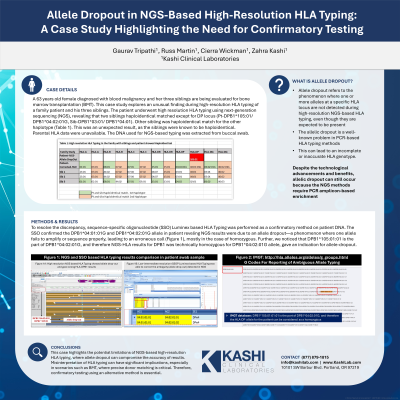
Body: Case details: A 63 years old female diagnosed with blood malignancy and her three siblings are being evaluated for bone marrow transplantation (BMT). This case study explores an unusual finding during high-resolution HLA typing of a family patient and his three siblings. The patient underwent high resolution HLA typing using next-generation sequencing (NGS), revealing that two siblings haploidentical matched except for DP locus (Pt-DPB1*105:01/ DPB1*04:02:01G, Sib-DPB1*03:01/ DPB1*04:01). Other sibling was haploidentical match for the other haplotype (Table 1). This was an unexpected result, as the siblings were known to be haploidentical. Parental HLA data were unavailable. The DNA used for NGS-based typing was extracted from buccal swab. Methods and
Results: To resolve the discrepancy, sequence-specific oligonucleotide (SSO) Luminex based HLA Typing was performed as a confirmatory method on patient DNA. The SSO confirmed the DPB1*04:01:01G and DPB1*04:02:01G allele in patient reveling NGS results were due to an allele dropout—a phenomenon where one allele fails to amplify or sequence properly, leading to an erroneous call (Figure 1), mostly in the case of homozygous. Further, we noticed that DPB1*105:01:01 is the part of DPB1*04:02:01G, and therefore NGS-HLA results for DPB1 was technically homozygous for DPB1*04:02:01G allele, gave an indication for allele-dropout.
Conclusions: This case highlights the potential limitations of NGS-based high-resolution HLA typing, where allele dropout can compromise the accuracy of results. Misinterpretation of HLA typing can have significant implications, especially in scenarios such as BMT, where precise donor matching is critical. Therefore, confirmatory testing using an alternative method is essential.