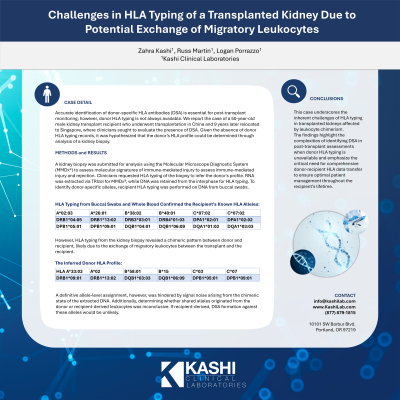
Body: Accurate identification of donor-specific HLA antibodies (DSA) is essential for post-transplant monitoring; however, donor HLA typing is not always available. We report the case of a 50-year-old male kidney transplant recipient who underwent transplantation in China and 9 years later relocated to Singapore, where clinicians sought to evaluate the presence of DSA. Given the absence of donor HLA typing records, it was hypothesized that the donor’s HLA profile could be determined through analysis of a kidney biopsy. A kidney biopsy was submitted for analysis using the Molecular Microscope Diagnostic System (MMDx) to assess molecular signatures of immune-mediated injury to assess immune-mediated injury and rejection. Clinicians requested HLA typing of the biopsy to infer the donor's profile. RNA was extracted via TRIzol for MMDx, while DNA was retained from the interphase for HLA typing. To identify donor-specific alleles, recipient HLA typing was performed on DNA from buccal swabs. HLA typing from buccal swabs and whole blood confirmed the recipient’s known HLA alleles: A*02:03, A*26:01; B*38:02, B*40:01, C*07:02, C*07:02, DRB1*04:05, DRB1*13:02; DRB3*03:01, DRB4*01:03; DPA1*02:01, DPA1*02:02; DPB1*05:01, DPB1*09:01, DQB1*04:01, DQB1*06:09; DQA1*01:02, DQA1*03:03. However, HLA typing from the kidney biopsy revealed a chimeric pattern between donor and recipient, likely due to the exchange of migratory leukocytes between the transplant and the recipient. The inferred donor HLA profile suggested the presence of the following alleles: HLA A*33:03, A*02; B*58:01, B*15; C*03,C*07; DRB1*09:01, DRB1*13:02; DQB1*03:03, DQB1*06:09; DPB1*05:01, DPB1*09:01. However, definitive allele-level assignment was hindered by signal noise arising from the chimeric state of the extracted DNA. Additionally, determining whether shared alleles originated from the donor or recipient-derived leukocytes was inconclusive. If recipient-derived, DSA formation against these alleles would be unlikely.
Conclusion: This case underscores the inherent challenges of HLA typing in transplanted kidneys affected by leukocyte chimerism. The findings highlight the complexities of identifying DSA in post-transplant assessments when donor HLA typing is unavailable and emphasize the critical need for comprehensive donor-recipient HLA data transfer to ensure optimal patient management throughout the recipient’s lifetime.