(414) Detection of Loss of Heterozygosity in a Haploidentical Hematopoietic Cell Transplant Recipient - Challenges in Tumor Cell Isolation and Chimerism Analysis
Background: Donor lymphocyte infusion (DLI) is a common strategy for treating relapse following hematopoietic cell transplantation (HCT). However, in haploidentical transplants, relapse may be associated with loss of heterozygosity (LOH), where tumor cells downregulate the non-shared HLA haplotype, evading graft-versus-leukemia (GvL) effects. In such cases, DLI may induce a rejection effect and prove ineffective. LOH detection requires isolating tumor blasts via cell sorting using CD34 and tumor-specific markers (e.g., CD56 or CD117) to facilitate genetic testing. This is complicated by the low frequency (0.03–0.09%) of CD34+ cells in peripheral blood, limiting available DNA for analysis.
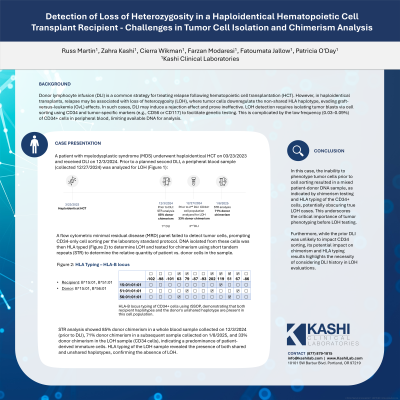
Case Presentation: A patient with myelodysplastic syndrome (MDS) underwent haploidentical HCT on 03/23/2023 and received DLI on 12/3/2024. Prior to a planned second DLI, a peripheral blood sample (collected 12/27/2024) was analyzed for LOH. Next-generation sequencing (NGS) failed to detect tumor cells, prompting CD34-only cell sorting as the flow cytometry laboratory standard protocol. DNA isolated from these cells was then HLA typed to determine LOH and tested for chimerism using short tandem repeats (STR) to determine the relative quantity of patient vs. donor cells in the sample. STR analysis showed 85% donor chimerism in a whole blood sample collected on 12/3/2024 (prior to DLI), 71% donor chimerism in a subsequent sample collected on 1/8/2025, and 33% donor chimerism in the LOH sample (CD34 cells), indicating a predominance of patient-derived immature cells. HLA typing of the LOH sample revealed the presence of both shared and unshared haplotypes, confirming the absence of LOH.
Conclusion: In this case, the inability to phenotype tumor cells prior to cell sorting resulted in a mixed patient-donor DNA sample, as indicated by chimerism testing and HLA typing of the CD34+ cells, potentially obscuring true LOH cases. This underscores the critical importance of tumor phenotyping before LOH testing. Furthermore, while the prior DLI was unlikely to impact CD34 sorting, its potential impact on chimerism and HLA typing results highlights the necessity of considering DLI history in LOH evaluations.