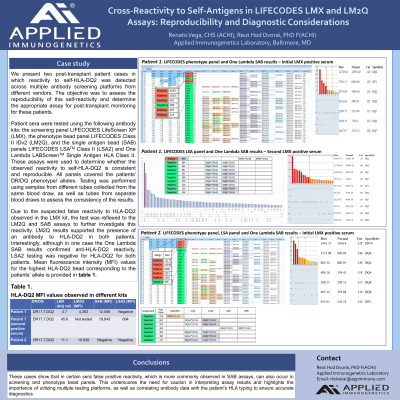
Body: We present two post-transplant patient cases in which reactivity to self-HLA-DQ2 was detected across multiple antibody screening platforms from different vendors. The objective was to assess the reproducibility of this self-reactivity and determine the appropriate assay for post-transplant monitoring for these patients. Patient sera were tested using the following antibody kits: the screening panel LIFECODES LifeScreen XP (LMX), the phenotype bead panel LIFECODES Class II IDv2 (LM2Q), and the single antigen bead (SAB) panels LIFECODES LSATM Class II (LSA2) and One Lambda LABScreenTM Single Antigen HLA Class II. These assays were used to determine whether the observed reactivity to self-HLA-DQ2 is consistent and reproducible. All panels covered the patients’ DR/DQ phenotype/ alleles. Testing was performed using samples from different tubes collected from the same blood draw, as well as tubes from separate blood draws to assess the consistency of the results. Due to the suspected false reactivity to HLA-DQ2 observed in the LMX kit, the test was reflexed to the LM2Q and SAB assays to further investigate this reactivity. LM2Q results supported the presence of an antibody to HLA-DQ2 in both patients. Interestingly, although in one case the One Lambda SAB results confirmed anti-HLA-DQ2 reactivity, LSA2 testing was negative for HLA-DQ2 for both patients. Mean fluorescence intensity (MFI) values for the highest HLA-DQ2 bead corresponding to the patients’ allele is provided in table 1. Table 1. HLA-DQ2 MFI values observed in the different kits
Conclusion: These cases show that in certain sera false positive reactivity, which is more commonly observed in SAB assays, can also occur in screening and phenotype bead panels. This underscores the need for caution in interpreting assay results and highlights the importance of utilizing multiple testing platforms, as well as correlating antibody data with the patient’s HLA typing to ensure accurate diagnostics.