– Associate Laboratory Director, Northwestern University, United States
Aim: A bimodal cell distribution – two distinct peaks in fluorescence intensity – can be observed in flow cytometry crossmatch (FCXM) that could lead to unexpected positive FCXM. Here, we investigated the frequency of bimodal distributions in donor cells, explore the benefits of conducting autologous FCXM in these instances, and examine the factors that may contribute to this bimodal distribution.
Methods: We performed a retrospective review of all flow crossmatches performed in our laboratory between 03/2024 – 03/2025. FCXMs were performed on T and B cells isolated from peripheral blood using EasySep and treated with pronase.
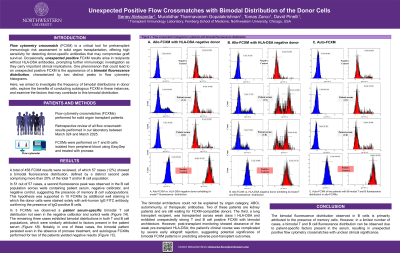
Results: Of the 458 FCXMs reviewed, 57 cases (12%) exhibited a significant second peak of >20% of the total T and/or B cell population. In 51/57 cases, the second peak was observed in the B cell population in wells containing patient serum, negative calibrator, and negative control. This suggests the presence of memory B cell subpopulations, which was confirmed in 10 FCXMs by additional wells of donor cells stained with anti-human IgG FITC antibody alone. In 3 FCXMs we observed a patient serum-specific bimodal T cell distribution not seen in the negative calibrator and control wells (Figure 1). 3/57 patients exhibited bimodal distribution of both T and B cell, which we also attributed to factors present in the patient serum. Notably, FCXM performed for one of these patients without pronase still demonstrated the bimodal T and B cell distribution, and autologous FCXMs performed for 2 of the patients were negative. In addition, bimodal architecture could not be explained by other factors like organ category, ABOi, autoimmunity, or therapeutic antibodies treatment. While two kidney patients are still waiting for a compatible donor offer, one lung patient was transplanted across a weak Class I HLA-DSA with an unexpectedly strong T and B cell positive FCXM demonstrating bimodal distribution. Although this patient tested negative for HLA-DSA post-transplant, her clinical course has been complicated by severe allograft rejection early post-transplant.
Conclusion: The bimodal distribution observed in B cells is primarily attributed to the presence of memory cells. However, in a limited number of cases, a bimodal T and B cell distribution can be observed due to patient-specific factors present in the serum, resulting in unexpected positive FCXMs with unclear clinical significance.