– Clinical Laboratory Manager, Vitalant, United States
Body: As the field shifts to greater reliance on virtual crossmatches, accurately assessing a patient’s HLA sensitization is more important than ever. We present two cases where sole reliance on single antigen bead (SAB) testing would have restricted donor offers.
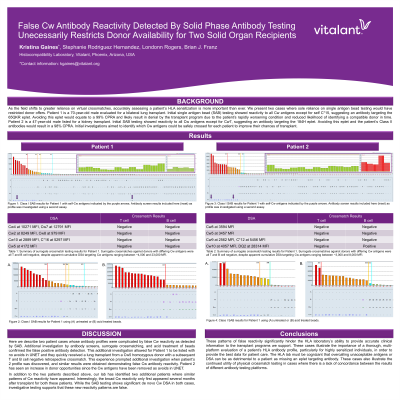
First, a 70 yo patient evaluated for a bilateral lung transplant. Initial SAB testing showed reactivity to all Cw antigens (Ags) except for self C*15 with an antibody targeting the 65QKR eplet. Avoiding this eplet would equate to a 99% CPRA, likely resulting in denial by the transplant (txp) program due to their rapidly worsening condition and reduced likelihood of identifying a compatible donor. Initial investigations aimed to identify which Cw Ags could be safely crossed. Surrogate crossmatches against donors with differing Cw Ags were all T and B cell negative, despite DSA between 3000 and 13000 MFI. Antibody (Aby) testing by screening beads or acid washed SABs were negative and consistent with false reactivity. The patient was subsequently listed with no avoids and quickly transplanted with a negative retrospective crossmatch.
The second patient is a 47 yo renal txp candidate. SAB testing showed reactivity against all Cw Ags, except for Cw7, with an Aby to the 184H eplet. Avoiding this eplet and the patient’s other class II abys would result in a 98% CPRA. Based on our lung patient experience, additional investigation was performed, and similar results were observed. Surrogate crossmatches were T and B cell negative despite apparent DSA between 3000 and 11000 MFI. Aby testing by screening beads or acid washed SAB were suggestive for false Cw reactivity. Based on this information, the Cw avoids were removed from UNET and the patient was successfully transplanted following a negative prospective crossmatch.
Conclusion: These cases illustrate the importance of a thorough, multi-platform evaluation of a patient’s Aby profile, particularly for highly sensitized individuals. The HLA lab must be cognizant that overcalling unacceptable Ags can be as detrimental as missing an eplet targeting Aby.
Future studies will evaluate how these patients perform post-txp to help determine if the discrepancies are due to false reactivity against denatured Ags or if it can be attributed to differences in antigen density in different assays, as suggested by recent publications.