Aim: It is known that the levels of pre-formed donor-specific antibodies (DSAs) typically trend down after liver or multi-organ transplant involving liver. The aim of the current study is to investigate the differential dynamics of locus-specific DSAs after liver transplantation.
Methods: A total of 112 pre-formed DSAs from 28 liver transplant recipients (9 liver alone, 15 Kidney+Liver, and 4 Heart+Liver) who had at least a serum sample collected at 1 month, 6 months, and 1 year post-transplant were included in this study. 1,000 MFI is used as the positive cutoff.
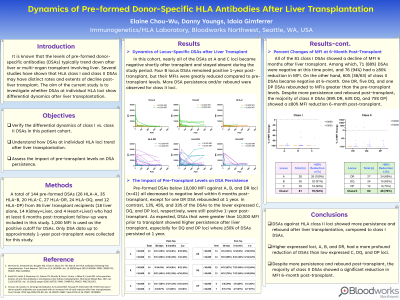
Results: As depicted in Table 1, pre-formed DSAs below 10,000 MFI against A, B, and DR loci (n=23) all decreased to negative levels within 6 months post-transplant. In contrast, 13%, 60%, and 33% of the DSAs to the lower expressed loci C, DQ, and DP, respectively, were still positive 1 year post-transplant. As expected, DSAs that were greater than 10,000 MFI prior to transplant showed higher persistence after liver transplant, especially for all of the class II loci where at least 50% of DSAs persisted at 1 year. Importantly, regardless of the locus, the vast majority (95%) of DSAs showed a remarkable reduction in MFI at 1 year post-transplant (Figure 1A, average percentage of MFI reduction for class I: 98%; class II: 90%), with the only exceptions of one C, four DQ, and one DP DSAs (6/112, 5%) that either remained at similar levels or increased after transplantation (Figure 1B).
Conclusion: Despite the limitation of small sample size, our analyses demonstrated that overall, DSAs against highly expressed HLA loci (A, B and DR) were cleared faster than DSAs against lower expressed C, DQ and DP loci. Furthermore, even though some class II DSAs persisted one year after liver transplantation, their MFIs were significantly decreased compared to the pre-transplant levels. Further studies to examine the clinical implication of the persistent DSAs are warranted.