– HLA Laboratory Manager, St. Jude Children's Research Hospital
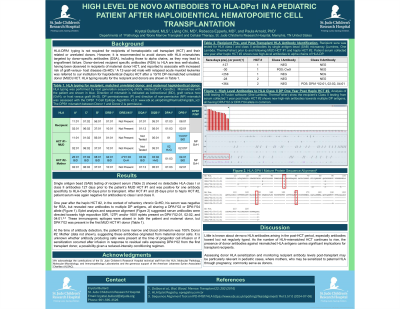
Body: HLA-DPA1 typing is not required for recipients of hematopoietic cell transplant (HCT) and their related or unrelated donors. However, it is recommended to avoid donors with HLA mismatches targeted by donor-specific antibodies, including those to alpha chains, as they may lead to engraftment failure. Donor-derived recipient specific antibodies (RSA) to HLA are less well-studied, having been observed in recipients of maternal donor HCT, and reported to associate with increased risk of graft-versus-host disease (GvHD). A 12-year-old male with relapsed acute myeloid leukemia was referred to our institution for haploidentical (haplo)HCT after a 10/10 DP-mismatched unrelated donor (MUD) HCT. Single antigen bead testing of recipient serum showed no detectable HLA class I and class II antibodies 4 months prior to and 7 months after MUD transplant, as well as 1 month prior to haploHCT. One year after second HCT in the context of refractory chronic GvHD, his serum was negative for RSA but revealed new antibodies to multiple DP antigens, all sharing a DPA1*02 or DPA1*04 allele. Eplet analysis suggested serum antibodies were directed towards high exposition 50R, 127P and/or 160V eplets, present on DPA1*02:01, 02:02, and 04:01. These immunogenic eplets were absent in both the patient and maternal donor, but DPA1*02 was present in the first MUD HCT donor. At the time of antibody detection, the patient’s blood and bone marrow chimerism were 100% and 99.5% Donor #2 respectively, suggesting these antibodies originated from maternal donor cells. It is unknown whether antibody producing cells were present at the time of progenitor cell infusion or if sensitization occurred after infusion in response to residual cells expressing DPA1*02 from the first transplant donor, a possibility given a reduced-intensity conditioning regimen.
Conclusion: Little is known about de-novo HLA antibodies arising in the post-HCT period, especially antibodies toward loci not regularly typed. As the numbers of HLA-mismatched HCT increase, the presence of donor antibodies against mismatched HLA antigens carries significant implications for transplant recipients. Assessing donor HLA sensitization and monitoring recipient antibody levels post-transplant may be particularly relevant in pediatric cases, where mothers, who may be sensitized to paternal HLA through pregnancy, commonly serve as donors.

.jpg "Krystal Bullard, MLS (ASCP) CM, CHT (ACHI), CSSGB (ASQ) photo")