– HLA Laboratory Associate Director, Midwest Transplant Network, United States
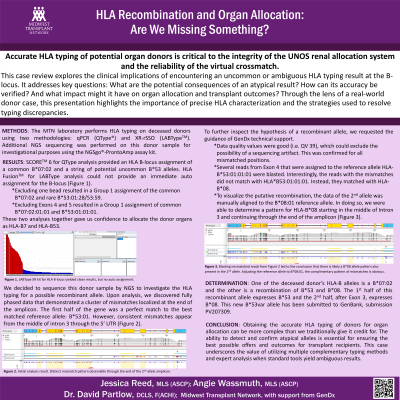
Body: The accurate HLA typing of potential organ donors is essential to the function of the UNOS renal allocation system and the success of the virtual crossmatch. So, what do you do when the HLA typing you obtain is “less common?” If it is not quite right, will there be clinical impact? How can you confirm it? Below we describe the tale of one such scenario for a donor’s HLA B-locus. The MTN laboratory performs HLA typing on deceased donors using both the QType and LABType assays. Additional NGS sequencing was performed using the ProntoAmp assay. The QType assay determined the HLA B-locus assignment to be a common B*07 and a string of potential uncommon B*53 alleles. The LABType assay could not provide an immediate auto assignment for the B-locus. Excluding one bead could force a common B*07 and a rare B*53 assignment, though the possible B*53 allele was not included in the QType allele string. The HLA-B assay kit we use is specifically XR, so we were able to exclude exon 4+; doing so allowed us to achieve common assignments for both B*07 and B*53. Following NGS sequencing, we determined one allele to be the common B*07:02 that we were expecting; the second allele was a pattern we had not yet come across in our sequencing journey. The first half of the gene was a perfect match to the best matched reference allele: B*53:01. However, consistent mismatches appear from the middle of intron 3 through the 5’ UTR (Image 1). With the guidance of GenDX support, we were able to clearly see the pattern for B*08 starting in the middle of intron 3 and continuing through the end of the amplicon (Image 2). What we had was a recombinant allele with the first half expressing B*53:01 and the second half expressing a common B*08 allele.
Conclusion: This case highlights the complexity and importance of accurate HLA typing in the organ allocation process, particularly when confronted with atypical alleles. Standard assays such as QType and LABType provided partial insights, but only using extended resolution kits and next-generation sequencing were we able to identify a recombinant allele composed of HLA-B*53:01 and a likely HLA-B*08 component. The ability to detect and confirm such recombination events is essential for ensuring the best possible match and outcome for transplant recipients. This case underscores the value of multiple complementary typing methods and expert analysis when standard tools yield ambiguous results.