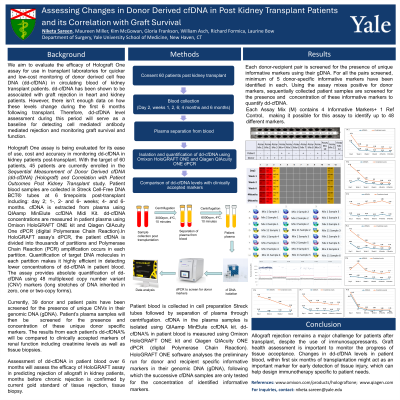
Aim: To evaluate the efficacy of Holograft One assay for use in transplant laboratories for quicker and low-cost monitoring of donor derived cell free DNA (dd-cfDNA) in circulating blood of kidney transplant patients. dd-cfDNA has been shown to be associated with graft rejection in heart and kidney patients. However, there isn’t enough data on how these levels change during the first 6 months following transplant. Therefore, dd-cfDNA level assessment during this period will serve as a baseline for detecting cell mediated/ antibody mediated rejection and monitoring graft survival and function.
Methods: Holograft One assay is being evaluated for its ease of use, cost and accuracy in monitoring dd-cfDNA in kidney patients post-transplant. With the target of 60 patients, 20 patients are currently enrolled in the Sequential Measurement of Donor Derived cfDNA (dd-cfDNA) (Holograft) and Correlation with Patient Outcomes Post Kidney Transplant study. Patient blood samples are collected in Streck Cell-Free tubes at 6 timepoints post-transplant including: day 2; 1, 2 and 6 weeks; 4- and 6- months. cfDNA is extracted from plasma using QIAamp MinElute ccfDNA Midi Kit. dd-cfDNA concentrations are measured in patient plasma using Omixon HoloGRAFT ONE kit and Qiagen QIAcuity One dPCR (digital Polymerase Chain Reaction). Use of dPCR in Holograft One assay helps in absolute quantification of dd-cfDNA using 48 multiplexed copy number variant (CNV) markers. By employing unique CNVs identified in donor and recipient’s genomic DNA (gDNA), this assay precisely identifies the concentration of donor’s DNA in patient’s blood.
Results: Informative markers have been successfully identified in gDNA of 14 donor-recipient pairs. Following sample collection at all 6 time points for a patient, these markers will be used for identification and quantification of dd-cfDNA in patient’s plasma. Sample # Unique markers in patient Unique markers in donor 1 8 7 2 9 14 3 10 7 4 7 7 5 7 8 6 13 6 7 14 5 8 1 5 9 9 13 10 9 12 11 8 6 12 8 6 13 14 7 14 10 10
Conclusion: Organ rejection is a major challenge post-transplant. Therefore, reliable strategies to monitor early graft dysfunction and tissue survival are required. Monitoring dd-cfDNA in patient’s blood within the first six months post-transplant might serve as an important marker of tissue injury to further help design patient specific therapy to address tissue rejection.
Footnotes: A proposed plan for this study has been submitted to WTC 2025 for a poster presentation. However, the current ASHI submission includes new updated data that hasn't been published/submitted elsewhere.