– Laboratory Director, Gift of Hope Organ & Tissue Donor Network, United States
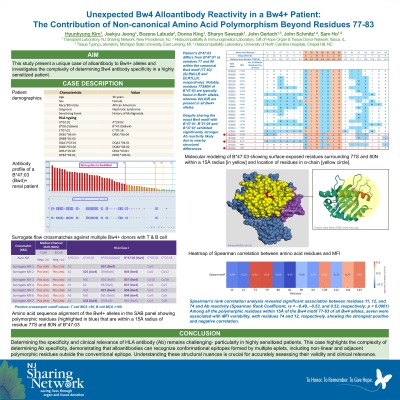
Body: Determining the specificity and clinical relevance of HLA antibody (Ab) remains challenging particularly in highly sensitized patients. We report a case of allo Ab to Bw4 in a Bw4+ renal patient. The patient is a 35-yo African American female with a history of 7 pregnancies. Her class I typing was A*02:01,29:02; B*08:01(Bw6),47:03(Bw4), and C*07:01,07:18. Her single antigen bead (SAB) profile included strong Ab to Bw4, along with others (Fig. 1). Ab specificities were confirmed through SAB testing with an alternative vendor’s reagents. The strong Bw4 reactivity was further confirmed by surrogate flow crossmatches against multiple Bw4+ donors with T-cell and B-cell MCS ranging 253-375 and 266-398, respectively. Interestingly SAB revealed strong reactivity (5000-22000 MFI) against all Bw4 antigens except B*47:01 (1700 MFI). This weak reactivity was consistently observed with the alternative vendor’s platform (2000 MFI vs 3100-19400 MFI for other Bw4 antigens). Sequence analysis indicated that patient’s B*47:03 differs from B*47:01 at residues 77 and 80 within the canonical Bw4 motif (77-83) (SLRNLLR and DLRTLLR, respectively). Notably, residues 77S80N of B*47:03 are typically found in Bw6+ alleles, whereas 82L83R are present in all Bw4+ alleles. Despite sharing the exact Bw4 motif with B*47:01, B*27:05 and B*37:01 exhibited significantly stronger Ab reactivity (6100 and 10800 MFI, respectively). Using pHLA3D structural modeling, we identified 6 and 4 residue differences between B*47:03 and B*27:05 and B*37:01, respectively, within a 15Å radius of the Bw4 motif (Table 1). Spearman’s rank correlation analysis revealed significant associations between residues 11, 12, and 74 and Ab reactivity (rs = –0.49, –0.53, and 0.52, respectively; p < 0.0001). Among all the polymorphic residues within 15Å of the Bw4 motif 77-83 of all Bw4 alleles, 7 were associated with MFI variability, with residues 74 and 12, respectively, showing the strongest positive and negative correlations.
Conclusion: This case highlights the complexity of determining Ab specificity, demonstrating that allo Ab can recognize conformational epitopes formed by multiple eplets, including non-linear and adjacent polymorphic residues outside the conventional epitope. Understanding these structural nuances is crucial for accurately assessing their validity and clinical relevance.