– Director-In-Training, UCLA Immunogenetics Center
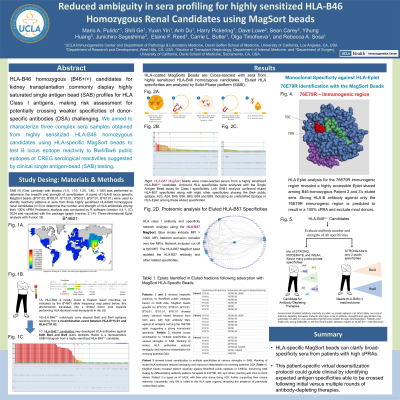
Aim: HLA-B46 homozygous candidates for kidney transplantation often show highly saturated SAB profiles for HLA Class I antigens, complicating risk assessment for crossing weaker donor-specific antibodies (DSA). We aimed to characterize three complex sera from HLA-B46 homozygous candidates using HLA-specific MagSort beads to test B locus epitope reactivity to Bw4/Bw6 public epitopes or CREG serological reactivities suggested by clinical SAB testing.
Methods: SAB I/II with titration and surrogate flow crossmatching was performed to assess sensitization breadth and strength. HLA-B locus MagSort beads were used to identify reactivity patterns in sera from three highly sensitized HLA-B46 homozygous renal candidates to determine the number and strength of HLA antibodies driving their 100% cPRA. Patients 1 and 2 are female primary candidates, and Patient 3 is a male regraft candidate,
Results: Patients 1 and 2 showed bispecific reactivity to Bw4/Bw6 public epitopes based on SAB data, with surrogate crossmatching confirming strong reactivity to both. MagSort beads specific for B*07:02, B*08:01, B*15:01, B*53:01, B*57:01, B*67:01 showed nearly identical eluted fractions from both sera, with high antibody titers against all antigens carrying the 76E79R eplet, suggesting a strong monoclonal specificity. Three-dimensional HLA protein structure analysis confirmed this eplet’s immunogenic position (Figure 1). Reactivity to eplets 66I and 163EW was identified, though masked in SAB; however, the strong sensitization to 76E79R requires matched donors for the candidates. Patient 3 showed broad sensitization to multiple specificities at various strengths in SAB. Ranking of eluted HLA antibodies reduced ambiguity and improved interpretation for crossing potential DSA (Table 1). MagSort beads revealed distinct reactivity against Bw4/Bw6 public epitopes or CREGs, enhancing SAB testing by differentiating antibody patterns for eplets of 43P76E, 66I, and others reacting with HLA-A and B alleles. Patient 3 is typed as A11/A24, with their prior donor being A29, further supporting their unique reactivity. Only, 66I is listed in the HLA eplet registry, revealing the presence of previously undescribed eplets.
Conclusion: Serum profiling performed using MagSort beads can support development of patient-specific virtual desensitization protocols to guide clinical practice for highly sensitized candidates.