– HLA Coordinator, Avera McKennan Hospital & University Center, United States
Body: All accredited histocompatibility laboratories are required to participate in proficiency testing (PT). HLA typing proficiency results are graded based on consensus and are considered good, acceptable, unacceptable, or ungraded. One reason why consensus is not always reached is that different typing platforms (e.g., SSO, RT- PCR, NGS, nanopore sequencing) and reporting strategies (G and P groups vs specific alleles) are used by the participating laboratories. This report highlights an instance of DPB1 reporting variability identified when a PT challenge, previously tested by RT-PCR, was re-tested during the validation phase of the Oxford Nanopore (ONT) sequencing platform. Testing by ONT revealed that long-read, whole genome sequencing provides a more accurate assessment of HLA alleles than other testing platforms.
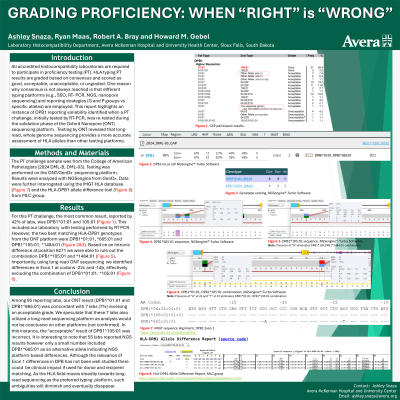
The PT challenge sample was from the College of American Pathologists (2024 DML-B, DML-03). Testing was performed on the ONT/GenDx sequencing platform. Results were analyzed with NGSengine from GenDx. Data were further interrogated using the IMGT HLA database and the HLA-DPB1 allele difference tool (https://apps.mlcgroupllc.com).
The most common result, reported by 42% of labs, was DPB1*01:01 and 105:01. This included our laboratory with testing performed by RT PCR. The two best matching HLA-DPB1 genotypes from the ONT platform were DPB1*01:01, *665:01 and DPB1*105:01, *1484:01. Based on an intronic difference at position 6271 we were able to rule out the combination DPB1*105:01 and 1484:01. Importantly, using long-read ONT sequencing we identified a difference in Exon 1 at positions 24 and 47, effectively excluding *105:01.
Conclusion: Among 95 reporting labs, our ONT result was concordant with 7 labs (7%) that received an acceptable grade reporting DPB1*01:01 and DPB1*665:01. We speculate that these 7 labs utilized long-read sequencing to achieve these results as this analysis would not be conclusive on other platforms, but this could not be confirmed. In this instance, the “acceptable” result of DPB1*105:01 was incorrect. Although the relevance of Exon 1 differences in DPB has not been well studied there could be clinical impact if used for donor and recipient matching. As the HLA field moves steadily towards long-read sequencing as the preferred typing platform, such ambiguities will diminish and eventually disappear.