– Associate Research Scientist, Columbia University, United States
Aim: Antigen presenting cells (APC) such as monocytes and dendritic cells express both activating and inhibitory receptors on their membrane. One such molecule is the immunoglobulin like transcript 3 (ILT3) which is upregulated in conjunction with inflammatory events and can be shed from the surface of APC into the circulation by metalloproteases or alternative splicing during inflammatory events. Our aim was to determine whether the increase of soluble ILT3 (sILT3) in the serum is associated with immune activation, as reflected in anti-HLA antibody production.
Methods: We have monitored the presence of Donor Specific Antibodies (DSA) by Luminex with single antigen beads and the quantified soluble ILT3 in sera collected from 35 pediatric recipients of heart transplants and 31 adult heart and/or lung recipients. Soluble ILT3 molecules were captured by anti-ILT3 monoclonal antibodies conjugated to microbeads. After incubation with fluorescein-conjugated monoclonal anti ILT3 antibodies, the fluorescence signal was measured using a BD FACSCanto™ clinical Flow Cytometry System.
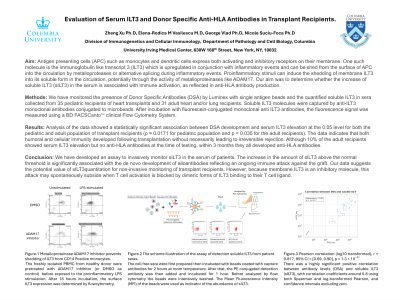
Results: Analysis of the data showed a statistically significant association between DSA development and serum ILT3 elevation at the 0.05 level for both the pediatric and adult population of transplant recipients (p ≈ 0.0171 for pediatric population and p = 0.035 for the adult recipients). The data indicates that both humoral and cellular immunity developed following transplantation without necessarily leading to irreversible rejection. Although 10% of the adult recipients showed serum ILT3 elevation but no anti-HLA antibodies at the time of testing, within 3 months they all developed anti-HLA antibodies.
Conclusion: We have developed an assay to invasively monitor sILT3 in the serum of patients. The increase in the amount of sILT3 above the normal threshold is significantly associated with the de novo development of alloantibodies reflecting an ongoing immune attack against the graft. Our data suggests the potential value of sILT3quantitation for non-invasive monitoring of transplant recipients. However, because membrane ILT3 is an inhibitory molecule, this attack may spontaneously subside when T cell activation is blocked by dimeric forms of ILT3 binding to their T cell ligand.