(224) The Impact of HLA Genotype Imputation on Allele Determination, Eplet Mismatch and Alloimmune Risk Categories in a Southeast Asian Cohort of Kidney Transplant Recipients
– Adjunct Assistant Professor, National University of Singapore, Singapore
Aim: HLA-DR/DQ molecular mismatch (mMM) categories had been published and validated as a prognostic biomarker of primary alloimmunity in several cohorts of kidney transplant recipients. However, the need for high-resolution genotyping is a barrier for centers in low-resource settings or retrospective analyses of historical cohorts where low-resolution typing was the standard. We examined the accuracy of imputed 2-field alleles, eplet mismatches, and mMM categories in a cohort whose donor and recipient HLA genotypes were obtained by Next-Generation Sequencing (NGS).
Methods: We analyzed 51 kidney transplant recipient and donor pairs. NGS HLA genotyping data were transformed to low resolution by removing the second field and considering serological splits. The low-resolution genotyping was imputed using HaploStats to generate high-resolution genotyping for HLA-A, -B, -C, DRB1, -DRB345, and -DQB1, guided by each individual’s self-identified race. HLA-DQA1 was imputed using published haplotype frequency reference standards describing HLA-DRB1-DQB1-DQA1. HLAMatchmaker (ABC v4.0 and DRDQDP v2.2) was used to determine the single molecule eplet mismatch. Recipients were categorized into mMM categories using previously published thresholds.
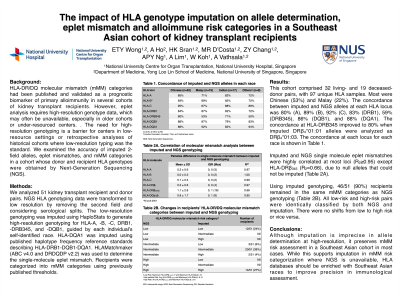
Results: This cohort comprised 32 living- and 19 deceased-donor pairs, with 97 unique HLA samples. Most were Chinese (54%) and Malay (20%). The concordance between imputed and NGS alleles at each HLA locus was 80% (A), 89% (B), 92% (C), 83% (DRB1), 60% (DRB345), 86% (DQB1), and 88% (DQA1). The concordance at HLA-DRB345 improved to 86% when imputed DRβ4*01:01 alleles were analyzed as DRβ4*01:03. The concordance at each locus for each race is shown in Table 1. Imputed and NGS single molecule eplet mismatches were highly correlated at most loci (R2≥0.95) except HLA-DRβ345 (R2=0.66), due to null alleles that could not be imputed (Table 2A). Using imputed genotyping, 46/51 (90%) recipients remained in the same mMM categories as NGS genotyping (Table 2B).
Conclusion: Although imputation is imprecise in allele determination at high-resolution, it preserves mMM risk assessment in a Southeast Asian cohort in most cases. While this supports imputation in mMM risk categorization where NGS is unavailable, HLA databases should be enriched with Southeast Asian races to improve precision in immunological assessment.