– Clinical Consulting Scientist, IGEN/AFIP, Brazil
Aim: It is currently unknown whether low-level donor-specific HLA antibodies (DSA) affect engraftment in pediatric patients undergoing hematopoietic cell transplantation (HCT). Thus, we report a case series assessing low-level DSAs before and after transplant in a reference pediatric HCT service.
Methods: Low-level DSAs were defined as those that are positive (MFI>300) in the Luminex Single Antigen Bead (SAB) assay but negative in Flow Cytometry Crossmatch (FCXM). DSA evaluation was conducted with One Lambda's SAB assay. FCXM was performed using the GoHalifaster protocol. Desensitization strategies were tailored to the patient's disease and clinical status. SAB testing was repeated on day zero (graft infusion) and day +2 to monitor potential DSA rebound. Chimerism analysis was performed using the STR method.
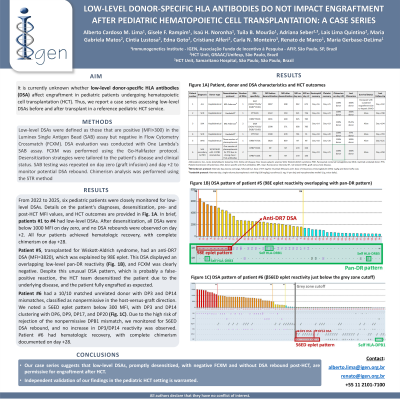
Results: From 2022 to 2025, six pediatric patients were closely monitored for low-level DSAs. Details on the patient's diagnoses, desensitization, pre- and post-HCT MFI values, and HCT outcomes are provided in Figure 1A. In brief, patients #1 to #4 had low-level DSAs. After desensitization, all DSAs were below 1,000 MFI on day zero, and no DSA rebounds were observed on day +2. All four patients achieved hematologic recovery, with complete chimerism on day +28. Patient #5, transplanted for Wiskott-Aldrich syndrome, had an anti-DR7 DSA (MFI=3,820), which was explained by 98E eplet. This DSA displayed an overlapping low-level pan-DR reactivity (Figure 1B), and FCXM was clearly negative. Despite this unusual DSA pattern, the HCT team desensitized the patient due to the underlying disease, and the patient fully engrafted. Patient #6 had a 10/10 matched unrelated donor with DP3 and DP14 mismatches, classified as nonpermissive in the host-versus-graft direction. We noted a 56ED eplet pattern below 300 MFI, with DP3 and DP14 clustering with DP6, DP9, DP17, and DP20 (Figure 1C). Due to the high risk of rejection of the nonpermissive DPB1 mismatch, we monitored for 56ED DSA rebound, and no increase in DP3/DP14 reactivity was observed. Patient #6 had hematologic recovery, with complete chimerism documented on day +28.
Conclusion: Our case series suggests that low-level DSAs, promptly desensitized, with negative FCXM and without DSA rebound post-HCT, are permissive for engraftment after HCT. Independent validation of our findings in the pediatric HCT setting is warranted.