– HLA lab Director in Training, The Children's Hospital of Philadelphia, United States
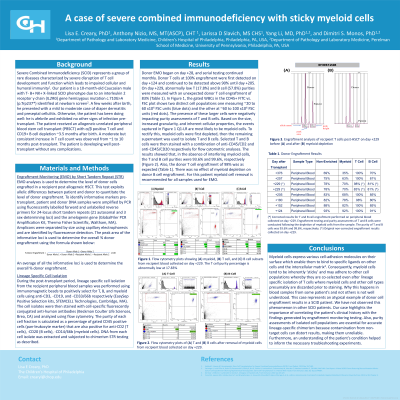
Body: Severe Combined Immunodeficiency (SCID) represents a group of rare diseases characterized by severe disruption of T cell development and function which leads to impaired cellular and humoral immunity. Our patient is a 10-month-old Caucasian male with T- B+ NK+ X-linked SCID phenotype due to an IL2RG gene hemizygous mutation identified at newborn screen. The patient received an allogeneic PBSC transplant with α/β positive T cell and CD19+ B cell depletion. Donor engraftment monitoring began on day +28, and serial testing continued monthly. Donor T cells at 100% engraftment were first detected on day +124 and continued to be detected above 90% until day +205. On day +229 abnormally low T (17.8%) and B cell (57.8%) purities were measured together with an unexpected donor T cell engraftment of 83%. Upon further critical review of the flow cytometry data, we deduced that the low lymphocyte purity results were due to contaminating myeloid cells which were negatively impacting the purity assessments of T and B cells. To rectify this, myeloid cells were first isolated, then the remaining supernatant was used to isolate T and B cells. Selected T and B cells were then stained with a combination of anti-CD45/CD2 and anti-CD45/CD20 respectively for flow cytometric analyses. The results showed that, in the absence of interfering myeloid cells, the T cell purity of 93.6% and the donor T cell engraftment of 98% were as expected. For this patient myeloid cell removal is recommended for all peripheral blood and bone marrow samples used for engraftment monitoring.
Conclusion: Myeloid cells express various cell-adhesion molecules on their surface which enable them to bind to specific ligands on other cells and the intercellular matrix. Consequently, myeloid cells tend to be inherently ‘sticky’ and may adhere to other cell populations whereby they are co-selected even after lineage specific isolation of T-cells where myeloid cells and other cell types presumably are discarded prior to staining. This case represents an atypical example of donor cell engraftment results in a SCID patient. We have not observed this phenomenon in other SCID patients. Our case highlights the importance of correlating the patient’s clinical history with the findings generated by engraftment monitoring testing. Furthermore, an understanding of the patient’s condition helped to inform the necessary troubleshooting experiments.