– Director, Technical Supervisor & Clinical Consultant , American National Red Cross, United States
Body:
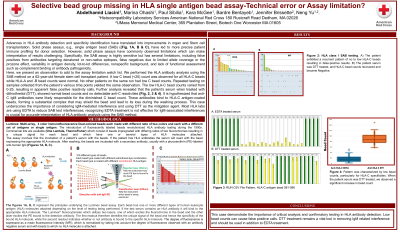
Background: Advances in HLA antibody detection and specificity identification have translated into improvements in organ and Stem cell transplantation. Solid phase assays, e.g., single antigen bead (SAB), have led to more precise patient immune profiling for donor selection. However, solid phase assays have commonly observed limitations which can make interpretation of results challenging. Specifically, the SAB assay is highly sensitive but has several limitations, including false positives from antibodies targeting denatured or non-native epitopes, false negatives due to limited allele coverage or the prozone effect, variability in antigen density, lot-to-lot differences, nonspecific background, and lack of functional assessment such as complement binding or antibody pathogenicity. Here, we present an observation to add to the assay limitation watch list. We performed the HLA antibody analysis using the SAB method on a 62-year-old female stem cell transplant patient. A low C bead ( <25) count was observed for all HLA-C beads while HLA-A and -B bead counts were normal. No other patients on the same run had low C bead counts. Repeated testing on samples collected from the patient’s various time points yielded the same observation. The low HLA-C bead counts varied from 0-25, resulting in apparent false positive reactivity calls. Further analysis revealed that the patient’s serum when treated with dithiothreitol (DTT), showed normal bead counts and no detectable anti-C reactivities (Fig. 1 & 2). It is hypothesized that anti-C IgM antibodies were likely responsible for the diminished C bead count. These antibodies bind to HLA-C antigen-coated beads, forming a substantial complex that may shield the bead and lead to its loss during the washing process. This case underscores the importance of considering IgM-mediated interference and using DTT as the mitigation agent. Most HLA labs are using EDTA to reduce SAB test interferences; recognizing EDTA treatment is not effective for IgM-associated interferences is crucial for accurate interpretation of HLA antibody analysis using the SAB method.
Conclusion: This case demonstrates the importance of critical analysis and confirmatory testing in HLA antibody detection. Low bead counts can cause false positive calls. DTT treatment remains a vital tool in removing IgM related interference and should be used in addition to EDTA treatment.

.jpg "Abdelhamid Liacini, PhD F(ACHI) HCLD/CC(ABB) photo")