Aim: This study examines the challenges and opportunities in pig-to-human xenotransplantation, focusing on Swine Leukocyte Antigens (SLA) as xenoantigens central to xenorecognition and graft rejection. We analyzed SLA and HLA similarities using ProtBert classifiers to explore potential HLA antibody cross-reactivity with SLA, particularly in sensitized patients.
Methods: Representative HLA and SLA sequences were obtained from IMGT/HLA and IPD-MHC databases. Sequences were aligned using MAFFT, with DIAMOND assessing sequence similarities and Jensen-Shannon Divergence evaluating evolutionary divergence. ProtBert models were employed for MHC classification, and homology modeling was used to highlight structural differences.
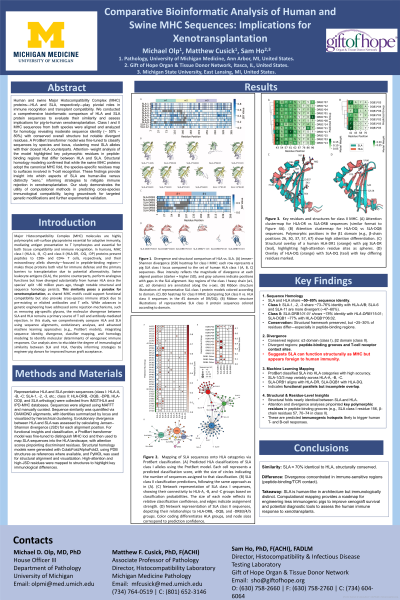
Results: SLA and HLA showed moderate identity, with class I SLA alleles (e.g., SLA-1, SLA-2) reaching up to 75% similarity to HLA-A and HLA-B. In contrast, SLA-6 and SLA-11 exhibited greater divergence (47-60%). Evolutionary analysis highlighted significant divergence in peptide-binding domains. ProtBert mapping assigned SLA alleles to multiple HLA categories; SLA-1 and SLA-2 showed connections to HLA-A and HLA-B, while SLA-4 and SLA-6 demonstrated weaker alignments (Fig). Residue-level mapping identified high-divergence regions in T-cell receptor interaction sites, pinpointing polymorphic sites that may drive immune recognition differences.
Conclusion: Our study underscores SLA as xenoantigens in rejection, showing potential HLA antibody cross-reactivity with SLA. Structural similarities exist despite differences in immune recognition sites, primarily in antigen-binding grooves. Strategic genetic modifications and selective donor matching could reduce rejection risks, advancing xenotransplantation efforts. This research highlights the potential of computational tools in identifying molecular targets to improve transplant compatibility.