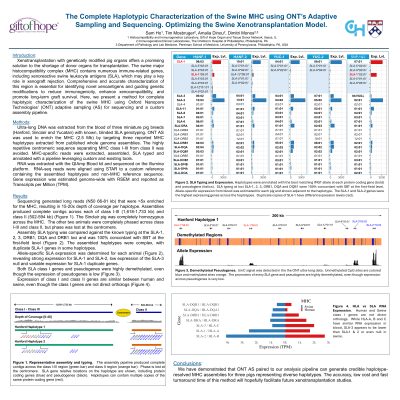
(110) The Complete Haplotypic Characterization of the Swine MHC Using ONT’s Adaptive Sampling and Sequencing. Optimizing the Swine Xenotransplantation Model.
– Laboratory Director, Gift of Hope Organ & Tissue Donor Network, United States
Aim: Xenotransplantation with genetically modified pig organs offers a promising solution to the shortage of donor organs for transplantation. The swine major histocompatibility complex (MHC) contains numerous immune-related genes, including xenoreactive swine leukocyte antigens (SLA), which may play a key role in xenograft rejection. Comprehensive and accurate characterization of this region is essential for identifying novel xenoantigens and guiding genetic modifications to reduce immunogenicity, enhance xenocompatibility, and promote long-term graft survival. Here, we present a method for complete haplotypic characterization of the swine MHC using Oxford Nanopore Technologies’ (ONT) adaptive sampling (AS) for sequencing and a custom assembly pipeline.
Methods: Ultra-long DNA was extracted from the blood of three pigs with known, blinded SLA genotyping. ONT AS was used to enrich the MHC (2.5 Mb) by targeting three reported MHC haplotypes extracted from published whole genome assemblies. The highly repetitive centromeric sequence separating MHC class I-III from class II was avoided. MHC-specific reads were extracted, assembled, SLA typed and annotated with a pipeline leveraging custom and existing tools.
Results: Sequencing generated long reads (N50 66-81 kb) that were >4x enriched for the MHC, resulting in 14-18x depth of coverage per haplotype. Assemblies produced complete contigs across each of class I-III (1,831-1,937 kb) and class II (627-649 kb). Two of the three animals were haplotype-resolved across class I-III and all three were fully resolved across class II. Assembly SLA typing was compared against the known typing and was 100% concordant. The assembled haplotypes were complex, with variable copies of some class I SLA genes per haplotype (Figure). Four hundred thirty-nine Ensembl protein-coding annotations were mapped to each haplotype, yielding >92% functional transcripts.
Conclusion: We have demonstrated that ONT AS paired to our analysis pipeline can generate credible haplotype-resolved MHC assemblies for three pigs representing diverse haplotypes. The accuracy, low cost and fast turnaround time of this method will hopefully facilitate future xenotransplantation studies.