– Manager R&D, Thermo Fisher Scientific (TDX), United States
Body: One therapeutic option for patients suffering from high-risk acute myeloid leukemia is allogeneic hematopoietic stem cell transplantation. Relapses after transplantations are still frequent and can cause mortality in transplant patients. There are different genomic mechanisms that allow leukemia cells to evade the donor immune system causing a relapse of the disease. This includes genomic loss of human leukocyte antigen (HLA) alleles (~30% in haploidentical transplants and 5-15% in unrelated transplants). Depending on the immune evasion mechanism, a clinical decision must be made to change treatment or select an alternative donor. Identifying loss of heterozygosity (LOH) during relapses remains critical for patient care. One Lambda LABType products combines the robustness of reverse-sequence-specific oligonucleotide (rSSO) typing method with the LABScan 100 or LABScan3D, to provide 11 loci HLA typing. This product is familiar to the HLA community and LABscan 100 or LABScan3D is generally available in labs that conduct HLA testing.
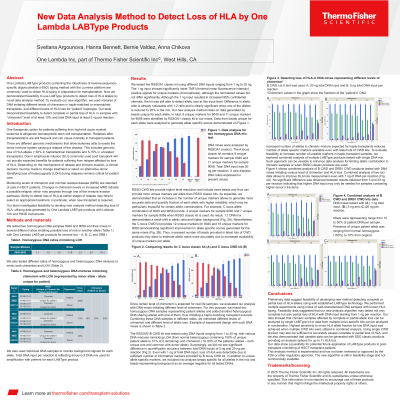
Conclusion: Our team investigated feasibility to develop new analysis method detecting loss of HLA while utilizing data generated by One Lambda LABtype products with LABscan 100 instrument. We tested different ratios of DNA mixtures to mimic LOH characteristics and ran all samples with One Lambda LABType products for several loci (see Fig.1). Our new algorithm allows to quantify ratios of selected alleles with high level of sensitivity to minor allele fraction and substantial level of precision. This algorithm is not commercially available currently. Fig 1. Analysis of LABType SSO Class I C Locus and LABType SSO Class I A Locus kits data testing two homozygous DNA samples mixed at different ratios

.jpg "Svetlana Argounova, MS photo")