– Postdoctoral Fellow, Children's Hospital of Philadelphia, United States
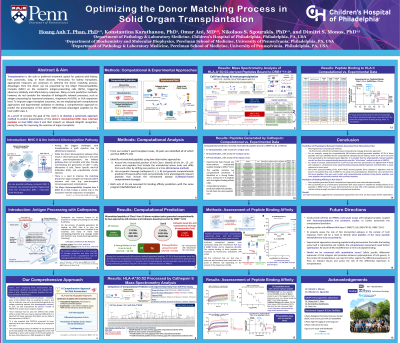
Aim: Transplantation is the sole or preferred treatment option for patients with kidney, liver, pancreatic, lung, or heart diseases, thereby necessitating appropriate measures to optimize the donor matching process. Alloantigen from the donor can be presented by the Major Histocompatibility Complex (MHC) on the recipient's antigen-presenting cells (APCs), triggering adversary antibody and inflammatory responses. Many current prediction methods, however, do not consider the interplay of biologically relevant processes, such as antigen processing by lysosomal proteases, chaperone HLA-DM, or HLA expression level. To improve organ transplant outcomes, we are employing both computational approaches and experimental validation to develop a comprehensive approach to predict the presentation of the donor’s MHC-derived alloantigen peptides by the host’s MHC class II.
Methods: From our center’s past transplant cases, we selected 16 pairs with recipients that were HLA-DRB1*11:01 positive and identified all mismatched donor-derived HLA peptides using two independent computational approaches: 1. identify all the 14-16 amino acid peptides containing the mismatched amino acids (all-inclusive approach); and 2. generate mismatched peptides based on predicted cathepsin enzymatic cleavage using ProsperousPlus (enzymatic approach). Peptides generated by both approaches were further assessed for binding affinity prediction with NetMHCIIpan-4.3, resulting in a range of binding strength to DRB1*11:01. Experimentally, we utilize mass spectrometry to confirm the identity of peptides bound to DRB1*11:01 from in vitro cathepsin digestion. Predicted mismatched peptides were synthesized along with recombinant DRB1*11:01 and its chaperone HLA-DM; the relative binding of these peptides was evaluated via fluorescence polarization (FP). Additionally, HLA expression levels was explored by identifying the extent of polymorphisms of the promoter regions of the HLA genes.
Results: We found that the first computational method detected a notable portion of peptides more than the second method, suggesting that the enzymatic approach generates less, yet potentially more physiologically relevant peptides. FP assay demonstrated that 56% of predicted outcomes were concordant with the predicted categorization as being strong, weak, or non-binders.
Conclusion: Our experimental data suggested that computational approaches have merit, yet they require further optimization.

.jpg "Hoang Anh T. Phan, PhD photo")