Aim: The presence of anti-HLA antibodies in patients poses challenges to transplantation. The precise detection of these antibodies by single antigen bead (SAB) assays have greatly improved successful long-term outcomes for transplantation patients. Currently, the focus of the SAB assays is on the detection of the anti-HLA IgG antibodies. However, as noted by Zhang and Jordan, IgM is the first immunoglobulin produced and may persist in many patients. In addition, Taupin and colleagues observed that the presence of anti-HLA IgM can interfere with anti-HLA IgG signals. To further understand anti-HLA IgM and IgG presence in transplantation patients, we surveyed samples with anti-HLA IgG signals greater than 1000. To investigate how the presence of anti-HLA IgM affects anti-HLA IgG signal, we focused on a sample with overlapping signals for both types of antibodies.
Methods: LABScreen Single Antigen assays were performed on 324 samples. Magnetic beads coated with specific HLA variants (MagSort) were used for absorption and elution on serum 145 to confirm eplet targeted by anti-HLA antibodies. DTT treatment was used to remove anti-HLA IgM signals.
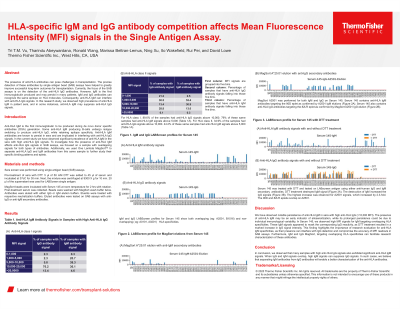
Results: For HLA class I, 89.6% of the samples had anti-HLA IgG signals above 10,000. 79% of these same samples had anti-HLA IgM signals above 5,000 (Table 1A). For HLA class II, 34.9% of the samples had anti-HLA IgG signals above 10,000. 44.2% of these same samples had anti-HLA IgM signals above 5,000 (Table 1A). Serum 145 contains anti-HLA IgM antibodies targeting the 90D eplet as confirmed by MagSort A0101 and A2501 IgM elutions (Figure 1A and 1C). Serum 145 also contains anti-HLA IgG antibodies targeting the 82LR eplet as confirmed by MagSort A2501 IgG elution (Figure 1B and 1D). The IgM signals were confirmed by DTT treatment, which destroyed the signals (Figure 1E). The destruction of IgM increased the IgG signals (Figure 1F). The highest increase was observed for A2501 signals, which increased by 2.3-fold. The 90D and 82LR eplets overlap on A2501.
Conclusion: In conclusion, we observed that many samples with high anti-HLA IgG signals also exhibited significant anti-HLA IgM signals. When IgG and IgM signals overlap, high IgM signals can suppress IgG signals. In such cases, we believe that separating IgM antibodies from IgG antibodies will enable a better characterization of the anti-HLA antibodies.
Footnotes: One Lambda MagSort is for Research use Only. Results presented are solely for research purposes.