– R&D Manager, One Lambda / Transplant Diagnostics / Thermo Fisher Scientific, United States
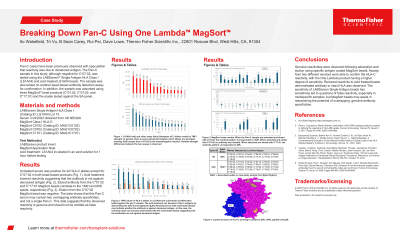
Body: Pan-Cw cases have been previously observed with speculation that reactivity was due to denatured antigen. The Pan-Cw sample in this study, although negative for Cw7, was tested using the LABScreen™ Single Antigen HLA Class I (LS1A04) and acid-treated LS1A04 beads. The sample was also tested on another bead-based antibody detection assay for confirmation. In addition, the sample was treated with three MagSort™ beads (C*01:02, C*07:02, and C*17:01) to see which antibodies get adsorbed and eluted. The results showed positive for all Cw beads except for Cw7 in both bead-based products. Acid treated beads had lowered reactivity suggesting that the antibody is not against denatured antigen. The Cw1 and Cw17 MagSort beads both pulled out unique antibodies specific to the 184H and 80K eplets, respectively. The Cw7 had no effect as expected, pulling no antibody out. The data shows that the Pan-Cw is two overlapping Cw antibodies, and in fact not a Pan-Cw. Data collected suggests that the observed reactivity is genuine and should not be omitted as false reactivity.
Conclusion: Genuine reactivities specific to the 80K and 184H eplets were detected and pulled out from the Pan-Cw sample. Both assays were able to confirm the Cw reactivity. The other bead-based product was only able to detect the antibodies because this was a strong binding serum. Further, there doesn’t seem to be evidence that this Pan-Cw reactivity was due to denatured antigen as the denatured acid-treated beads had a lower reactivity compared to untreated beads.

.jpg "Ito Wakefield photo")