– Histocompatibility Technologist II, Tulane University HLA Laboratory, United States
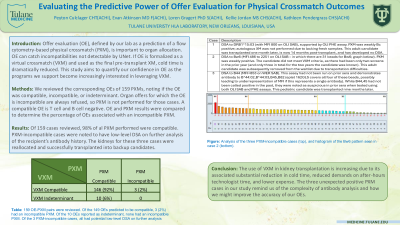
Aim: Offer evaluation (OE), defined by our lab as a prediction of a flow cytometry-based physical crossmatch (PXM), is important to organ allocation. OE can catch incompatibilities not detectable by UNet. If formalized as a virtual crossmatch (VXM) and used as the final pre-transplant XM1, cold time is dramatically reduced. This study aims to quantify our confidence in OE as the programs we support become increasingly interested in leveraging VXM.
Methods: For all PXMs performed over a 14-month period (12/2023-2/2025), we reviewed the corresponding OEs, noting if the OE was compatible, incompatible, or indeterminant. An indeterminant OE usually occurs when the most recent serum sample is too remote to support a reliable prediction. This does not preclude acceptance of the organ offer and subsequent PXM. Organ offers for which the OE is incompatible are refused, so PXM is not performed for those cases. A compatible OE is defined as T cell and B cell negative, driven by a comparison of waitlist candidate HLA antibody screen history with donor typing in the form of SSO or rtPCR. OE and PXM results were compared to determine the percentage of OEs associated with an incompatible PXM. This percentage was expected to be very low.
Results: 159 OE-PXM pairs were reviewed. Of the 149 OEs predicted to be compatible, 3 (2%) had an incompatible PXM. Of the 10 OEs reported as indeterminant, none had an incompatible PXM2. Of the 3 PXM-incompatible cases, all had potential low-level DSA on further analysis of the recipient’s antibody history, though one cannot rule out the possibility these PXM results were false positives3. The kidneys for these 3 cases were reallocated and successfully transplanted into backup candidates identified proactively by the transplant center.
Conclusion: The use of VXM in kidney transplantation is increasing due to its substantial reduction in cold time, reduced demands on after-hours technologist time, and lower expense. The safe use of VXM relies on well-characterized HLA antibody profiles as input. The three unexpected positive PXM cases in our study remind us of the complexity of antibody analysis and suggest the utility of incorporating OE and VXM tools into our lab to reduce analytical errors. As more centers move towards using OE as the final pre-transplant evaluation of HLA compatibility, minimizing the false-negative rate of OEs and ultimately VXMs is imperative.
Footnotes:1 An OE can serve as a virtual XM (VXM) and be used for prospective final XM if a current serum ( <60 days old) is used in the analysis, at least three sera were tested in the past year, a SAB assay was used within the past six months, the most recent sera demonstrate a consistent antibody profile, there have been no DSA in the past year, and there have been no sensitizing events in the past 90 days.
2 8 out of 10 indeterminant OEs were due to outdated serum samples (>6 months from OE request date.) Of the two remaining, one was due to possible weak DSA to C*07:02, and the other was due to weak DSA to DRB3*01.
3 In these three cases, the patients did not meet the Tulane Transplant Institute and Tulane HLA Laboratory criteria for transplant based on VXM alone. Therefore, a prospective PXM was required for all cases before proceeding to transplant.