– Director In Training , LifeLink Transplantation Immunology Lab, United States
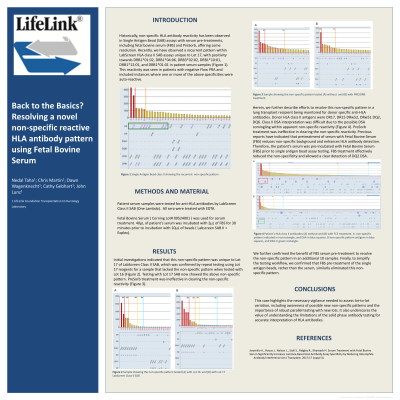
Body: Historically, non-specific HLA antibody reactivity has been observed in Single Antigen Bead (SAB) assays with serum pre-treatments, including fetal bovine serum (FBS) and PreSorb, offering some resolution. Recently, we have observed a recurrent pattern within LabScreen HLA class II SAB assays unique to Lot 17, with positivity towards DRB1*01:02, DRB1*04:06, DRB3*02:02, DRB1*10:01, DRB1*12:01, and DRB1*01:01 in patient serum samples. This reactivity was seen in patients with negative Flow PRA and included instances where one or more of the above specificities were auto-reactive. Initial investigations indicated that this non-specific pattern was unique to Lot 17 of LabScreen Class II SAB, which was confirmed by repeat testing using Lot 17 reagents for a sample that lacked the non-specific pattern when tested with Lot 16. Testing with Lot 17 SAB now showed the above non-specific pattern. Herein, we further describe efforts to resolve this non-specific pattern in a lung transplant recipient being monitored for donor specific anti-HLA antibodies. Donor HLA class II antigens were DR17, DR15 DRw52, DRw51 DQ2, DQ6. Class II DSA interpretation was difficult due to the possible DSA comingling within apparent non-specific reactivity (Figure 1). PreSorb treatment was ineffective in clearing the non-specific reactivity. Previous reports have indicated that pretreatment of serum with Fetal Bovine Serum (FBS) reduces non-specific background and enhances HLA antibody detection. Therefore, the patient’s serum was pre-incubated with Fetal Bovine Serum (FBS) prior to single antigen bead assay testing. FBS treatment effectively reduced the non-specificity and allowed a clear detection of DQ2 DSA. We further confirmed the benefit of FBS serum pre-treatment to resolve the non-specific pattern in an additional 10 samples. Finally, to simplify the testing workflow, we confirmed that FBS pre-treatment of the single antigen beads, rather than the serum, similarly eliminated this non-specific pattern.
Conclusion: This case highlights the necessary vigilance needed to assess lot-to-lot variation, including awareness of possible new non-specific patterns and the importance of robust parallel testing with new lots. It also underscores the value of understanding the limitations of the solid phase antibody testing for accurate interpretation of HLA antibodies.