Aim: Determining the donor-derived fraction of cell-free DNA (dd-cfDNA) in whole blood enables non-invasive monitoring of graft damage in organ transplant recipients. For this, cfDNA needs to be isolated to prevent skewing of the perceived donor fraction by genomic DNA (gDNA). Here, we present a quality control assay (gFreeQC) that quantifies isolation yield while determining cfDNA purity. The assay could be used in the context of multiple cfDNA clinical applications, including cfDNA chimerism monitoring assays.
Methods: gDNA was sheared using sonication to mimic the properties and sizing of cfDNA and subsequently mixed with intact gDNA, creating mixtures to simulate a relevant range of 0.5-10% gDNA “contamination”. cfDNA quantity and purity was assessed using a duplex detection of two targets; a long fragment to indicate genomic DNA contamination and a short fragment to represent total DNA. qPCR was performed using an initial activation step, followed by 50 cycles of PCR using ROX detection for the long fragment and FAM detection for the short fragment. Quantification was achieved by comparison to a dilution series of genomic DNA included in the same run. Precision and linearity were studied using 3 ng/μL DNA input. Between-run and within-run precision were determined based on 4 runs with 2 replicates each.
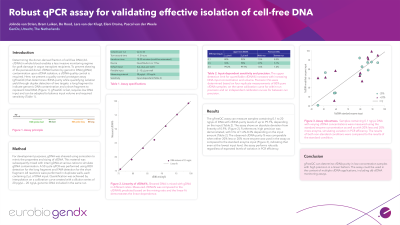
Results: The assay can measure samples containing 0.5 to 8 ng/µL of DNA with as little as 0.5% gDNA contamination. The assay shows an average deviation from linearity of up to 2%. in the range of 0.5% - 10% gDNA. Furthermore, high precision was demonstrated, with within-run and between-run CV% of up to 2.1% and 7.5%, respectively. Robustness of the assay was also demonstrated when 90-110% volumes of primer/probe mix and master mix were applied.
Conclusion: The gFreeQC assay is a robust and reliable assay able to determine the quantity and purity of cfDNA after isolation.