Aim: Short read next generation sequencing (NGS) offers superior resolution of HLA typing compared to Real-time PCR (RT-PCR),yet RT-PCR is the most feasible and preferred method in many transplant centers for deceased donor typing due to its rapid turnaround time.However, RT-PCR may be unable to resolve ambiguities and incorrectly assign alleles, thereby negatively impacting virtual crossmatch.Here, we sought to compare RT-PCR and NGS for deceased donor typing and impact on virtual crossmatch.
Methods: Our cohort comprised of 32 deceased donors who were typed by Thermofisher/One Lambda LinkSeq™ at all 11 loci.The most likely common alleles given by SureTyper™ were converted to serological equivalents for virtual crossmatch assessment.Each donor was retrospectively typed at high resolution by NGS (CareDx-AlloSeq TM and Immucor- MIAFORA TM).RT-PCR and NGS HLA typings were compared at the two-field, serological equivalent, and P group levels to determine potential impact on virtual crossmatch.
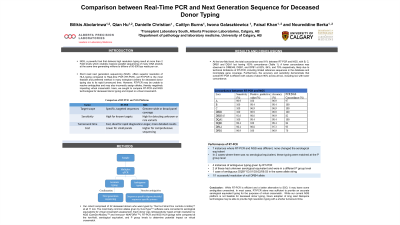
Results: At the two-field level, total concordance was 91% between RT-PCR and NGS, with B, C, DRB1 and DQA1 loci having 100% concordance (Table 1).A lower concordance was observed in DRB345, DQB1, and DPB1 at 82%, 84%, and 70% respectively, likely due to technical limitations of RT-PCR, including incomplete gene coverage. Accuracy and sensitivity demonstrate that RT-PCR is efficient with values of above 90% across all loci, including loci with lower concordance.Of the 7 instances where two-field typing was different between RT-PCR and NGS, none changed the serological equivalent,or in cases with no serological equivalent, typings were matched at the P group level.Thus, RT-PCR results are unlikely to negatively affect the accuracy of virtual crossmatch. Also, there were 4 instances of ambiguous typing;2 of which had unknown serological equivalents and were in a different P group, and one had DQB1*03/01/03:02/06:03 in a string.Lastly,the only null allele found was at DRB4 locus and was accurately resolved by RT-PCR.
Conclusion: While RT-PCR is efficient,it may leave some ambiguities unresolved.In most cases,RT-PCR alone was sufficient to provide an accurate serological equivalent typing for the purposes of virtual crossmatch.While our current NGS platform is not feasible for deceased donor typing, future adoption of long read Nanopore technologies may be able to provide high resolution typing with a shorter turnaround time.