(412) Relapse of Acute Myeloid Leukemia Detected During Routine Cell Subset Purity Assessment Via Flow Cytometry as Part of the Myeloid Cell Lineage-Specific Chimerism Analysis: A case report
– HLA Assistant Director In Training, Vitalant, United States
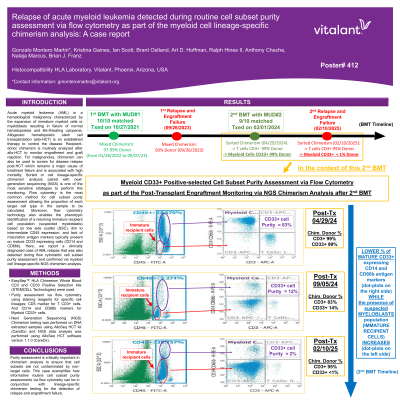
Body: Acute myeloid leukemia (AML) is a hematological malignancy characterized by the expansion of immature myeloid cells or myeloblasts resulting in failure of normal hematopoiesis and life-threating cytopenia. Allogeneic hematopoietic stem cell transplantation (allo-HCT) is an established therapy to control the disease. Recipient-donor chimerism is routinely analyzed after allo-HCT to monitor engraftment and graft rejection. For malignancies, chimerism can also be used to screen for disease relapse post-HCT which remains a major cause of treatment failure and is associated with high mortality. Sorted or cell lineage-specific chimerism analysis paired with next-generation sequencing (NGS) is one of the most sensitive strategies to perform this monitoring. Flow cytometry is the most common method for cell subset purity assessment allowing the proportion of each target cell type in the sample to be calculated. Moreover, flow cytometry technology also enables the phenotypic identification of an abnormal myeloblast population based on the typically observed low side scatter (SSC) and dim to intermediate CD45 expression in addition to an evaluation of antigen expression profile, since myeloblasts often differ from mature cells by expressing immature markers and lacking antigens typically present on mature cells. Here, we report a clinically diagnosed case of AML relapse that was also detected based on the flow cytometric cell subset purity assessment and phenotypic characteristics displayed overtime post-HCT (increased majority of CD33 positively selected myeloid cells from peripheral blood showing lower levels of CD14/CD66b mature cells markers based on staining antibodies used), while occurring this in conjunction with the impending failure of engraftment quantified via myeloid cell lineage-specific NGS chimerism analysis.
Conclusion: Purity assessment is critically important in chimerism analysis to ensure that cell subsets are not contaminated by non-target cells. Furthermore, this reported clinical case exemplifies how informative routine cell subset purity assessment via flow cytometry can be also in the context of relapse detection when the molecular surveillance of hematopoietic chimerism by lineage-specific analysis identifies failure of engraftment.