– Immunogenetics Clinical Development Manager, Children's Hospital of Philadelphia
Aim: Donor-derived cell-free DNA (dd-cfDNA) detection is rapidly becoming a standard in post-transplant monitoring of allograft rejection. While there are an increasing number of dd-cfDNA assays commercially available for in-lab testing, validation of a dd-cfDNA test for clinical use is extensive and expensive. Choosing a cell-free DNA (cfDNA) extraction method is the first step into establishing a dd-cfDNA test. Based on our expected test volume and current laboratory setup, we evaluated three cfDNA extraction kits for yield, purity, and inter-tech reproducibility to choose the optimal extraction method.
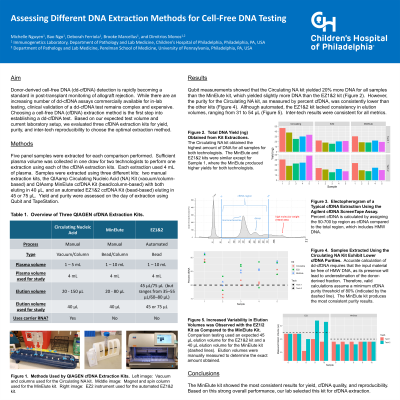
Methods: Five panel samples were extracted for each comparison performed. Sufficient plasma volume was collected in one draw for two technologists to perform one extraction using each of the cfDNA extraction kits. Each extraction used 4 mL of plasma. Samples were extracted using three different kits: two manual extraction kits, the QIAamp Circulating Nucleic Acid (NA) Kit (column/vacuum-based) and QIAamp MinElute ccfDNA Kit (bead-based) with both eluting in 40 µL, and an automated EZ1&2 ccfDNA Kit (bead-based) eluting in 45 µl. Qubit and TapeStation measurements were taken the same day.
Results: Qubit measurements showed that the Circulating NA kit yielded 20% more DNA for all samples than the MinElute kit, which produced slightly more DNA than the EZ1&2 kit. However, the purity for the Circulating NA kit, as measured by percent cfDNA, was consistently lower than the other two kits. Although automated, the EZ1&2 kit lacked consistency in elution volumes, ranging from 31 to 54 µl. Inter-tech results were consistent for all metrics.
Conclusion: The MinElute kit provided the most consistent results for yield, cfDNA quality, and reproducibility, and therefore was chosen as our cfDNA extraction kit.

.jpg "Deborah Ferriola, CHT(ACHI) photo")