– Co-Director Histocompatibility and Immunogenetics Laboratory, Rush University Medical Center, United States
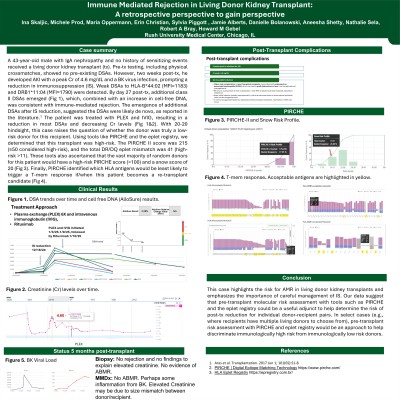
Body: A 43-year-old male with IgA nephropathy and no history of sensitizing events received a living donor kidney transplant (tx). Pre-tx testing, including crossmatches, showed no pre-existing DSAs. However, two weeks post-tx, he developed AKI with a peak Cr of 4.6 mg/dL and a BK virus infection, prompting a reduction in immunosuppression (IS). Weak DSAs to HLA-B*44:02 (MFI=1183) and DRB1*11:04 (MFI=1790) were detected. By day 27 post-tx, additional class II DSAs emerged (Fig 1), which combined with an increase in cell-free DNA was consistent with immune-mediated rejection. The emergence of additional DSAs subsequent to IS reduction suggested the DSAs were likely de novo, as reported in the literature.1 The patient was treated with PLEX and IVIG, resulting in a reduction in most DSAs and decreasing Cr levels (Fig 1&2). With 20-20 hindsight, this case raises the question of whether the donor was truly a low-risk donor for this recipient. Using tools like PIRCHE and the eplet registry, we determined that this transplant was high-risk. The PIRCHE II score was 215 (≥50 considered high-risk), and the total DR/DQ eplet mismatch was 41 (high-risk >11). These tools also ascertained that the vast majority of random donors for this patient would have a high-risk PIRCHE score (>100) and a snow score of 20 (Fig 3). Finally, the PIRCHE identified which HLA antigens would be least likely to trigger a Tmem response if/when this patient becomes a re-transplant candidate.
Conclusion: This case highlights the risk for AMR in living donor kidney transplants and emphasizes the importance of careful management of IS. Our data suggest that pre-transplant molecular risk assessment with tools such as PIRCHE and the eplet registry could be a useful adjunct to help determine the risk of post-tx reduction in individual donor-recipient pairs. In select cases (e.g., where recipients have multiple living donors to choose from), pre-transplant risk assessment with PIRCHE and the eplet registry would be an approach to help discriminate immunologically high risk from immunologically low risk donors.
Footnotes: Ref: Arias et al. Transplantation. 2017 Jun 1;101(6S):S1-8. https://www.pirche.com HLA Eplet Registry